


Knowledge Centre · Tool · Excavation volume calculator
Excavation Volume Calculator and Anchor Length
Enter the length, width and depth of the excavation and the excavation volume calculator shows the in-place volume, the bulked volume to haul and the number of truck loads. In addition, the same page works out ground anchor lengths. However, the results are a first estimate; the final quantities come from the design.
Tool
Excavation volume and anchor length
Excavation
In-place and bulked volume, truck loads
Anchors
Free length and bond length
Result
First estimate; the design sets final quantities
Prepared by
Abdullah Çetintaş, Geological Engineer
Updated
November 2026
Excavation volume calculator: volume and truck loads
First, enter the length, width and depth in metres for an excavation with vertical shoring. The bulking factor shows how much more space the excavated soil takes up once it is loaded onto a truck. You can also change the truck capacity to match your own vehicles.
Geometric volume for a vertical, shored excavation. Slopes, ramps and the thickness of the retaining wall change the volume. Bulking is roughly 1.10–1.40 for soils and higher for rock; the site investigation decides.
Ground anchor length calculator
For a prestressed ground anchor, the total length is the free length plus the bond length. That is why you only need to enter the number of anchors and the two lengths; the calculator then shows the length per anchor and the total quantity.
The shoring design sets the free and bond lengths. In clay the bond length for the same load is longer than in sand or rock. Anchor heads and walers are not included.
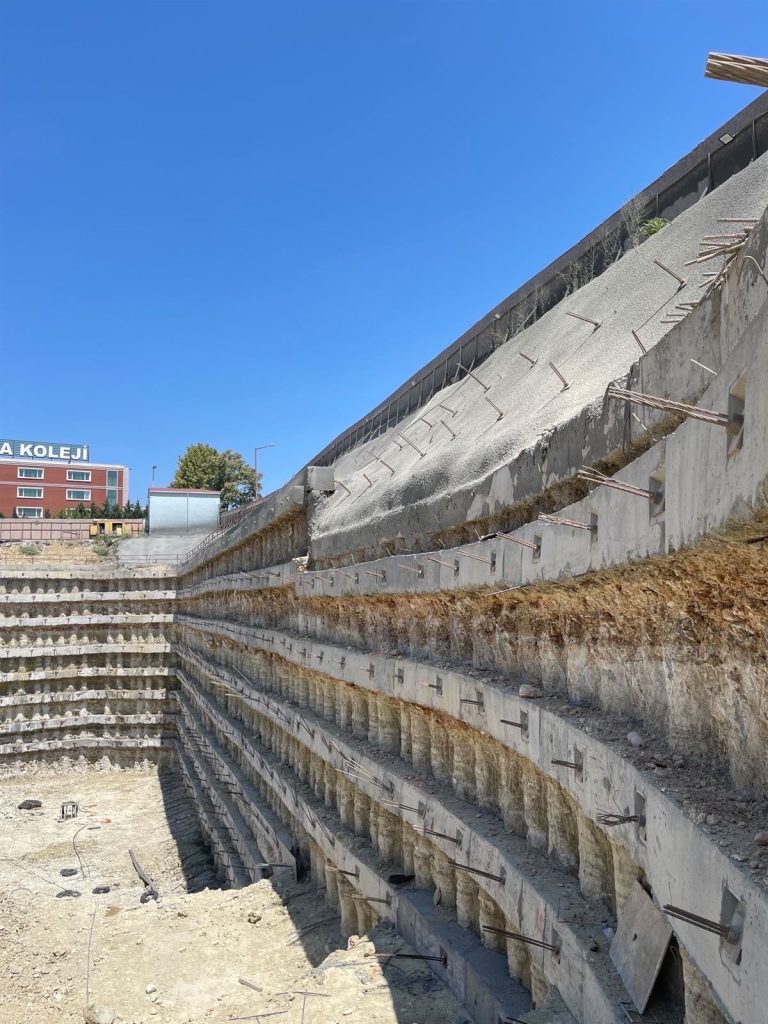
For example, the 800 anchors on our deep excavation in Küçükçekmece added up to 30,000 m. In particular, in clay the bond length gets longer for the same load, so the total grew. We describe this job on our Küçükçekmece project page.
How is excavation volume calculated?
For a vertical excavation, the in-place volume is V = length × width × depth. However, excavated soil loosens, so the volume to haul is this result multiplied by the bulking factor. Finally, the number of truck loads is the bulked volume divided by the truck capacity.
| Soil | Approximate bulking factor |
|---|---|
| Sand and gravel | 1.10–1.15 |
| Clay | 1.20–1.40 |
| Weathered rock | 1.30–1.50 |
| Sound rock | 1.50 and above |
For example, a 30 × 20 m excavation that is 12 m deep has an in-place volume of 7,200 m³. With a bulking factor of 1.25, the volume to haul is 9,000 m³; as a result, that means 600 loads with a 15 m³ truck.
What does the result leave out?
- Sloped excavations, ramps and the thickness of the retaining wall change the volume.
- The site investigation and the site itself set the actual bulking factor.
- Anchor heads, waling beams and stressing tests are not included in the anchor quantity.
- Also, the tipping site, haul distance and traffic restrictions change how long the loads take.
That is why the result does not replace a quote. In addition, we explain the items that drive shoring costs in our shoring cost guide. For a firm figure, send us your documents through the Request a Quote form.
Questions about the excavation volume calculator
The questions we hear most often about the calculators.
Calculation and results
What is the bulking factor?
It is the ratio of the volume the soil takes up once loosened to its in-place volume. For example, 1.25 means that 1 m³ of soil in the ground takes up about 1.25 m³ on the truck.
What is the difference between free length and bond length?
The bond length is the grouted part of the anchor that transfers the load to the ground. In contrast, the free length is the part between the wall and the bond zone, which does not transfer load. The shoring design sets both.
Does the calculator give a price?
No, it only gives volumes and quantities. We do not publish prices on the site; instead, we prepare our quotes from the quantities.

Request a quote for your excavation
Send us the site investigation, the architectural drawings and the excavation depth. Then we will work out the shoring and anchor solution with you, based on quantities.