


Services · Deep foundations · Bored piles
Bored Piles: Piled Foundations and Retaining Walls
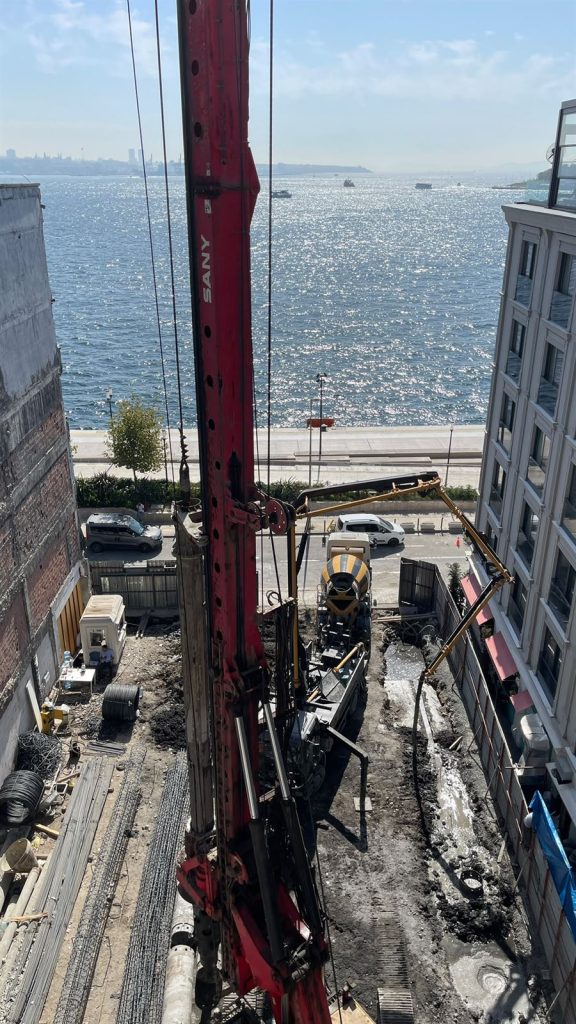
Bored piles are cast-in-place piles: we drill a shaft, lower a steel cage into it and fill it with concrete. We install bored piles up to Ø2000 mm and 70 m long in Istanbul, across Türkiye and in Central Asia.
Pile diameter
Up to Ø2000 mm
Pile length
Up to 70 m
Supported excavation
Up to 30 m deep
Drilling methods
Dry, cased, bentonite or polymer
Rigs
Sany SR285R, Jintai SD28W, 60 t crawler crane
Region
Türkiye and Central Asia
What are bored piles?
A bored pile is a reinforced concrete deep foundation element cast in place. First we drill a shaft to the pile diameter. Then we lower the reinforcement cage and place the concrete from the base upwards.
Bored piles carry building loads into the ground in two ways. The first is shaft friction along the pile surface. The second is end bearing at the pile toe. The site investigation and the structural design show which of the two governs.

When do you need bored piles?
- When the upper soils cannot carry the load or settlement would be too large
- For heavy loads such as tall buildings, bridges and machine foundations
- When a deep excavation needs a retaining wall to protect neighbouring buildings and roads
- On plots with high groundwater, fill or soft clay
- On sites at risk of liquefaction or slope movement, together with ground improvement
Where do we use bored piles?
We use bored piles for two main jobs: carrying the structure and holding the sides of a deep excavation. The same rig does both. However, the design and construction details differ.
Piled foundations
Carry building, factory and warehouse loads down to a firm layer. Where needed, they work together with a raft.
Bored pile retaining walls
Hold the soil and neighbouring buildings around a basement dig. In deep excavations, prestressed ground anchors support the wall.
Bridges and infrastructure
Large-diameter piles for bridge piers, viaducts and railway structures.
Slopes and landslides
A row of piles, together with anchors and drainage, holds a moving slope.
Types of bored pile retaining walls
Groundwater and soil decide how we arrange the piles in a retaining wall. Without water, spaced piles with shotcrete between them are often enough. On the waterfront or with high groundwater, however, the wall needs secant piles. For example, in Karaköy we installed 100 secant piles of Ø65 cm for a foundation below sea level.

How do we build bored piles?
On site, each pile goes through six steps. For every pile we record the drilled length, the layers we pass through and the volume of concrete placed.

- Setting out: We survey and mark the pile centres from the approved setting-out plan.
- Drilling: Depending on the ground, we use an auger, a drilling bucket or a rock core barrel. Each layer goes into the drilling log.
- Bore support: If the bore could collapse, we use temporary casing or bentonite or polymer fluid.
- Base cleaning and cage: We clean the base of the bore. Then the crane lowers the cage, which we assemble on site with our partner and fit with cover spacers.
- Tremie concrete: Concrete goes in through a tremie pipe from the bottom of the bore. The pipe tip stays inside the concrete throughout the pour.
- Pile head: We break off the weak concrete at the top down to cut-off level and prepare the pile for the cap.
The most common mistake we see on site: pouring concrete without a tremie pipe. The concrete mixes with water, segregates and the pile loses strength. That is why we use a tremie pipe in every bore that holds water or bentonite.
Drilling methods for bored piles
We choose the method from the site investigation, the groundwater and the pile length. Our crews use all three methods, and where needed we combine two in the same bore.
| Method | When we choose it | What we watch |
|---|---|---|
| Dry drilling | The bore stands on its own and there is no water; stiff clay, rock | Base cleaning and verticality |
| Cased drilling | Loose fill, sand and water in the upper layers; waterfront sites | Withdrawing the casing under control during the pour |
| Bentonite or polymer support | Deep, saturated sand and silt; long piles | Fluid density, level and cleaning before the pour |
On the waterfront and on reclaimed ground we usually work with casing. In dry ground and rock, the work moves faster. The hardest case comes when narrow streets meet high groundwater.
Bored pile diameters and concrete volume
Load, soil and rig decide the pile diameter. For example, in Küçükçekmece we installed 200 piles of Ø80 cm.
| Diameter | 1 m of pile, theoretical concrete | 20 m pile, theoretical concrete |
|---|---|---|
| Ø60 cm | 0.283 m³ | 5.65 m³ |
| Ø65 cm | 0.332 m³ | 6.64 m³ |
| Ø80 cm | 0.503 m³ | 10.05 m³ |
| Ø100 cm | 0.785 m³ | 15.71 m³ |
| Ø120 cm | 1.131 m³ | 22.62 m³ |
| Ø150 cm | 1.767 m³ | 35.34 m³ |
| Ø200 cm | 3.142 m³ | 62.83 m³ |
We worked out the volumes in the table with V = π × D² / 4 × L. Actual concrete use on site usually comes out a little higher, because the bore widens slightly during drilling. If the difference grows large, we look for the cause on site.
Bored pile quantity and concrete calculator
You can work out the total drilled length and the theoretical concrete volume for your project below. The result is for an early budget; the design sets the final quantities.
Optional: rough budget with your own unit rates
Rough budget: —
Theoretical geometric volume. Concrete use on site is usually slightly higher. Reinforcement, mobilisation and taxes are not included.
Quality control and testing of bored piles
Our quality control starts during construction. For every pile we record the drilled length, the layers, the reinforcement and the concrete volume. The client usually asks for PIT testing, and most specifications include it. When asked, our testing partner carries out the test.
| Test | What it shows | What it does not show |
|---|---|---|
| PIT (integrity test) | Changes in section and signs of defects along the pile | How many tonnes the pile can carry |
| CSL (crosshole sonic logging) | Concrete condition between tubes fixed to the cage | The zone outside the tubes in full |
| Static load test | Settlement under load and bearing capacity | The quality of the other piles on its own |
On the Karaköy project our testing partner checked the piles with PIT. We also took core samples from the jet grout columns on the same site.
Our bored pile projects
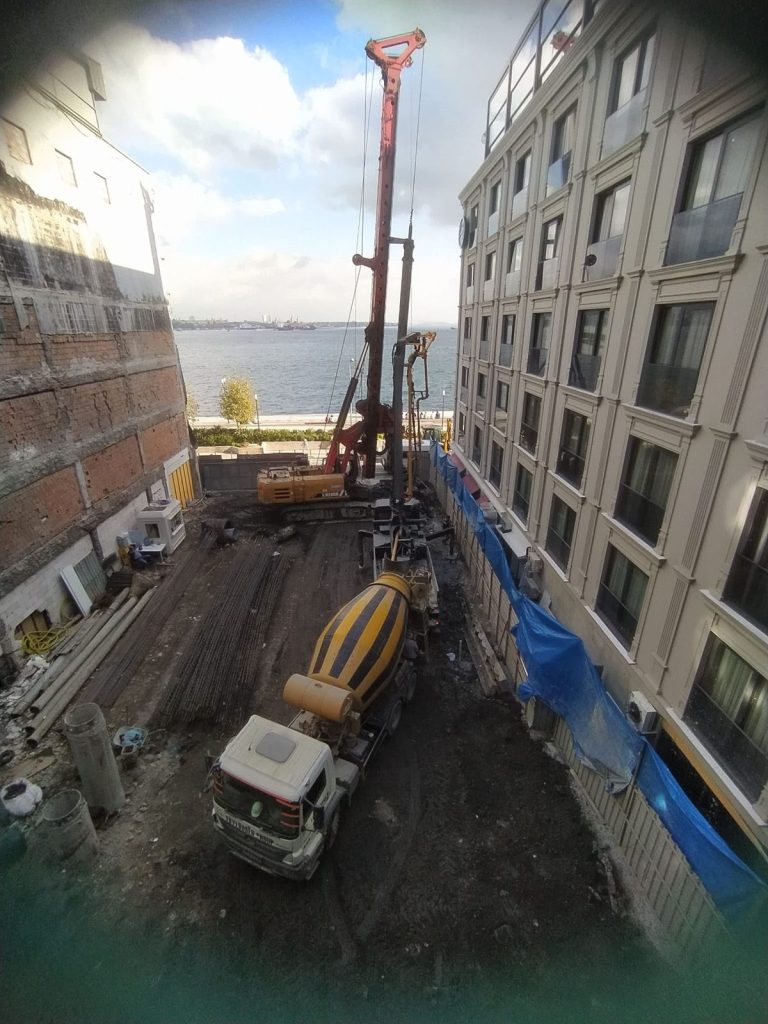
100 secant bored piles of Ø65 cm, 1,200 m in total. The foundation sat about 4 m below sea level.
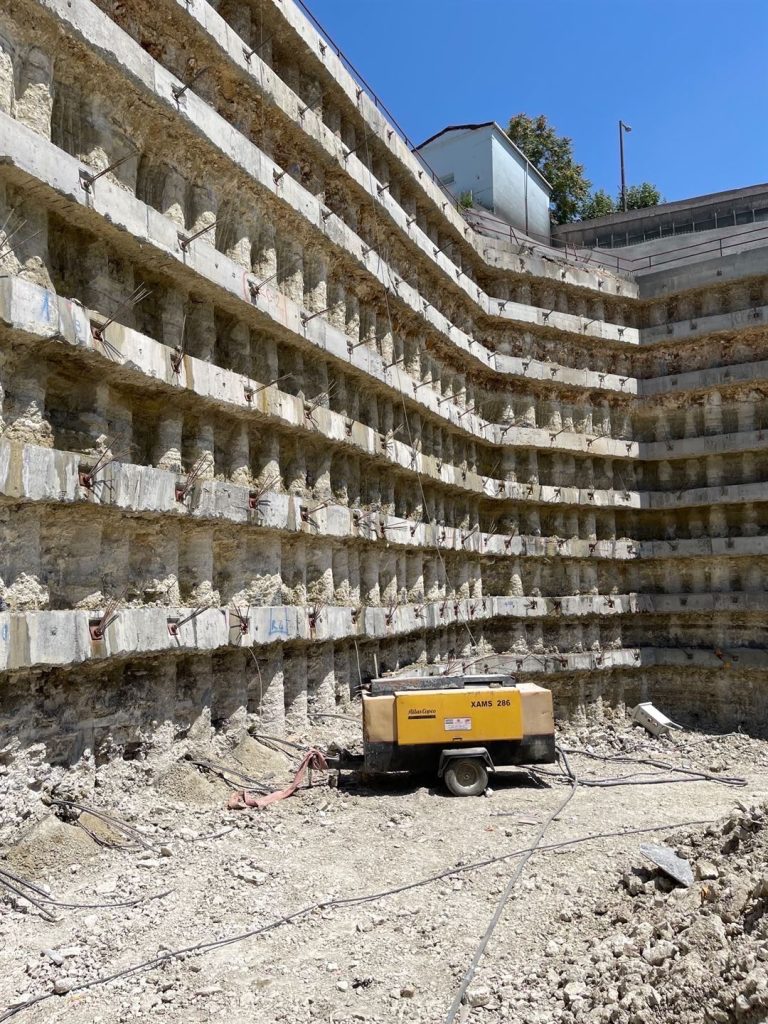
Aydın University Annex Building
200 bored piles of Ø80 cm (6,000 m) and 800 prestressed anchors; a deep excavation in clay.
Our founder, Abdullah Çetintaş, also worked on many bored pile jobs in earlier roles. Examples include 30,000 m of piles at the Yenikapı Event Area, piles socketed into basalt in Trabzon and the Qusbegi bridge piles in Tashkent. See our founder’s earlier projects with photos.
Bored pile videos
On our YouTube channel we explain bored pile work in short videos. The video below shows why a tremie pipe is essential. It is in Turkish and also uses footage from other sites for training purposes.

You can find all our videos on our YouTube channel.
What does the price of bored piles depend on?
We price bored piles per metre. However, no single rate fits every job. Even the same Ø80 cm pile costs a different amount on different ground and sites. That is why we do not publish rates and quote from the quantities instead.
- Diameter, length and total quantity
- Ground and rock: rock drilling is slower and has its own rate
- Groundwater: the need for casing or bentonite
- Reinforcement weight and cage assembly
- Site access, working hours and the working platform
- Mobilisation distance and the tests you need
What to send for a quote
- Site investigation report and borehole logs
- Pile layout plan and a list of diameters, lengths and numbers
- Reinforcement details and concrete class (structural design)
- The shoring design, if there is one, and details of neighbouring buildings
- Site address, access width and target programme
Write to us even if some documents are missing. We make an initial assessment from what you have and fill the gaps together. There are also fair ways to cut cost. For example, correct soil parameters can shorten the piles, or a different shoring layout can reduce their number. We review such options with our design partner.
Frequently asked questions about bored piles
We have grouped the questions we receive by who asks them. If yours is not here, call us or write through the quote form.
Buying and cost
How much does a Ø80 cm bored pile cost per metre?
We do not publish a fixed rate, because the price depends on the ground, the length and the quantity. Send the borehole logs and the pile list and we will quote from the quantities. Our quote shows drilling, rock drilling, cage assembly and mobilisation on separate lines.
Who supplies the concrete and the steel?
On most jobs the client buys the concrete and the reinforcing steel. We assemble the cages on site with our partner. This way cage production keeps pace with drilling and the work never waits for steel.
Why do bored pile quotes differ so much?
Usually the scope differs. For example, one quote may leave out rock drilling, casing or testing. Line up the items first, then compare the unit rates.
How do you measure pile length for payment?
The contract should state at the outset which length counts: from the working level or from cut-off level. We record each pile’s drilled length, rock head level and concrete volume. As a result, payment claims do not turn into disputes.
Why is mobilisation a separate item?
Moving the rig, crane and equipment to site and setting them up costs the same however many piles there are. On small jobs this cost takes a larger share. So we show it on its own line.
Project managers
How long does bored piling take?
The number of piles, their length, the amount of rock and the number of rigs set the duration. With the quote we provide a programme based on the quantities. Working hours matter too; for example, narrow streets in Karaköy limited us to 10:00–17:00.
How many metres can one rig drill per day?
A single figure would mislead you. Daily output depends on the ground and rock, the rig’s power and the drilling tools. On top of that, concrete arriving on time, cages being ready and spoil leaving the site all affect the pace. So we build the programme from the borehole logs and site conditions.
How many rigs do you have?
Our fleet includes two piling rigs, a Sany SR285R and a Jintai SD28W, and a 60-tonne crawler crane for the cages. We agree the number of rigs with you based on the programme.
Main contractors
Will bored piling damage the building next door?
We form bored piles by drilling, not by driving. As a result, vibration stays low compared with driven piles. Still, the risk next to existing buildings is not zero. Before work starts, we recommend recording the condition of neighbouring buildings with photos and a signed report.
Bored piles, jet grouting or micropiles?
Bored piles lead when loads are large and the design calls for piled foundations. Micropiles suit tight spaces and work inside existing buildings. Jet grouting is the choice when the ground needs improving in place or water needs cutting off. Many projects combine them; in Karaköy, for example, we used bored piles for the shoring and jet grouting under the foundation.
Do you work outside Türkiye?
Yes. We work in every province of Türkiye and have also completed work in Tashkent, Uzbekistan. For distant sites we fix the rig and crew plan before work starts.
Site engineers
What do we need to prepare on site for the rig?
The rig needs a level, firm working platform that can carry its track loads. We plan the platform with you for the rig model and the ground. Also mark out the route for truck mixers, the cage storage area and a water supply in advance.
What happens if we hit water while drilling?
Water does not mean you cannot build the pile. If the bore starts to collapse, we use casing or bentonite. We also place the concrete from the base with a tremie pipe, so it does not mix with water.
Why is a tremie pipe essential?
When there is water or bentonite in the bore, concrete dropped from the top segregates and loses strength. A tremie pipe carries the concrete to the bottom of the bore. Its tip stays inside the concrete for the whole pour, and the rising concrete pushes the water up and out.
How should we plan the concrete pours?
We pour each pile in one continuous operation. For this reason, we suggest agreeing pour times with the batching plant in advance and keeping truck mixers arriving one after another. Ordering slightly more than the theoretical volume prevents a half-poured pile.
What happens to the drilling spoil?
Spoil builds up at the pile head and goes to an agreed area on site. Taking it off site usually falls under the earthworks package. Our quote states clearly who is responsible for it.
Supervising engineers and inspectors
Who arranges PIT testing?
The client usually asks for PIT testing, and most specifications include it. When asked, our testing partner carries out the test. Before testing, the pile heads need to be clean and the concrete needs to have gained enough strength.
What records do you keep for each pile?
For each pile we record its number, drilled length, the layers passed, the rock head level and the concrete volume. We also note whether we used casing or bentonite. These records form the basis for payment and for reading test results.
What does it mean if a pile took more concrete than the theoretical volume?
A small overrun is normal, because the bore widens slightly during drilling. A clear overrun, however, can point to open-textured fill or a collapse in the bore. In that case we investigate the cause on site together.
Structural and geotechnical designers
How do you confirm pile capacity?
The approved design sets the piles; we build the diameter and length it specifies. If we meet an unexpected layer while drilling, we tell the designer at once. Confirming capacity needs a static load test, because PIT does not show it.
Which standards do you work to?
For construction we follow EN 1536 (execution of bored piles), which Türkiye adopts as TS EN 1536. Designers use TBDY 2018, the Turkish Building Earthquake Code, and Eurocode 7. On public works we also follow the client’s technical specification.
How long should a rock socket be?
There is no single correct length. Rock strength, jointing, pile diameter and load set the socket length. For example, on the Ramada Hotel project in Trabzon, where our founder worked, the piles sat in sockets cut into basalt.
When does negative skin friction become a problem?
If the soil around a pile settles more than the pile, it drags the pile down. New fill, consolidation of soft clay or a drop in groundwater can cause this. The design has to allow for this extra load.
Do you propose alternative pile layouts?
Yes. If our site experience points to a more economical pile layout or shoring system, we prepare a proposal with our design partner. The designer always makes the final decision.
Architects
How much basement space does a bored pile wall take?
The wall takes up the pile diameter plus a construction tolerance. The rig and the neighbouring building decide how close to the boundary we can drill. So we suggest settling the wall thickness with us at concept stage.
Owners and neighbours
Does my building need bored piles?
The site investigation and the structural design decide this. Plots with soft clay, fill, high groundwater or a liquefaction risk often need piled foundations. We can arrange the site investigation with our drilling partner.
Are bored piles earthquake resistant?
A piled foundation can carry earthquake loads down to firmer layers. A pile alone, however, does not prevent liquefaction. Where there is a liquefaction risk, the project may also need ground improvement, and the design must follow TBDY 2018.
Academics and students
What is the difference between bored piles and driven piles?
For bored piles we drill out the soil, then place reinforcement and concrete in the bore. Driven piles come ready-made, and a hammer drives them into the ground. As a result, bored piles cause less vibration and can reach much larger diameters.
What are primary and secondary piles in a secant wall?
First we install unreinforced primary piles with gaps between them. Then we drill reinforced secondary piles between them, cutting slightly into the primaries. The result is a continuous, watertight wall.
What is the group effect in piles?
When piles stand close together, the stresses in the soil around them overlap. Because of this, a pile group can carry a different load from one pile’s capacity multiplied by the number of piles. A group can also settle more than a single pile.

Sources
Request a quote for your bored piles
Send us your site investigation and pile list. We will prepare a quantity-based quote and programme together.