


Services · Ground improvement · Deep soil mixing
Deep Soil Mixing (DSM): Ground Improvement by Mixing in Place
Deep soil mixing (DSM) is a ground improvement method: a rotating tool with paddles mixes the soil with a cement-based binder in place. In Türkiye the method is known as derin karıştırma.

Method
Mechanical mixing
Binder
Cement-based; wet or dry
Column diameter
Equal to the mixing tool
Suitable ground
Soft clay, silt, loose sand
Standard
EN 14679
Region
Türkiye and Central Asia
What is deep soil mixing?
Deep soil mixing is a ground improvement method in which we mix the soil with a cement-based binder without removing it, so that it hardens in place. We drive a rotating shaft with paddles at its tip into the ground. Meanwhile the binder flows down the shaft, and the paddles mix it into the soil.
Once the mix hardens, a regular column forms in the ground with a diameter equal to the mixing tool. Also, because the soil stays in place, little spoil comes up to the surface.
There are two ways to add the binder. The wet method uses cement grout, while the dry method uses cement or lime powder. The water content of the ground and the design decide which one suits.
When do you need deep soil mixing?
- Fill or building loads on soft clay and silt would cause too much settlement
- A large area needs many columns, for example under roads and warehouses
- Loose sand needs its liquefaction risk reduced
- An excavation needs a wall that holds back water and soil
- Contaminated ground needs binding and stabilising in place
Deep soil mixing or jet grouting?
Both methods mix the soil with cement in place and form columns. However, they mix in different ways. In DSM rotating paddles do the work, while in jet grouting a high-pressure jet does it.

| Topic | DSM | Jet grouting |
|---|---|---|
| Mixing | Mechanical, with a paddle tool | With a high-pressure jet |
| Pressure | Low | Very high |
| Column diameter | Tool diameter; regular | Varies with the ground |
| Returning spoil | Little | Much more |
| Cement use | Relatively low | Relatively high |
| Best ground | Soft clay, silt, sand | Sand, gravel, fill; clay with Jet 2 |
| Obstructions and tight sites | Needs a large rig; struggles with obstructions | Small drill hole; reaches under existing buildings |
| Typical use | Improvement over large areas, under embankments | Cut-off under foundations, tight sites |
In short, DSM is often cheaper on large, open sites with soft ground. Under existing buildings, on narrow plots or in coarse gravel, by contrast, jet grouting comes first. We make the choice with you from the site investigation and the purpose.
Where do we use deep soil mixing?
We use DSM mostly over large areas and in soft ground. The purpose then decides how we lay out the columns.
Road and railway embankments
Reduces and speeds up the settlement of fill on soft ground.
Warehouse and factory floors
Strengthens the ground over large areas and controls floor settlement.
Liquefaction mitigation
Locks loose sand in place with a grid or cell layout.
Excavation walls
Overlapping columns hold back water and soil; steel sections can go inside where needed.
On motorway and large housing projects, for example, DSM often works together with bored piles. The piles carry the structure, and DSM reduces settlement of the soft ground around them.
How do we build DSM columns?
Each DSM column takes five steps. We mix the soil both on the way down and on the way up, so the column comes out more uniform.
- Setting out: We mark the column centres from the design.
- Down-stroke mixing: We rotate the tool into the ground and feed the binder down the shaft.
- Base: At the column base we turn the tool a few more times to complete the mix.
- Up-stroke mixing: We keep the tool turning as we withdraw it, so the soil mixes a second time.
- Record: For every column we log the depth, binder quantity and number of turns.
Uniform mixing decides the quality. Withdrawing the tool too fast or feeding the binder unevenly leaves unmixed soil in the column. That is why we keep the down and up speeds, the number of turns and the binder flow at the design values.
DSM column diameter and volume
The mixing tool sets the column diameter, so the diameter is known from the start. The ground and the target strength set the binder quantity. The table below shows the volume of treated ground in one metre of column.
| Column diameter | 1 m of column | 10 m of column |
|---|---|---|
| Ø60 cm | 0.283 m³ | 2.83 m³ |
| Ø80 cm | 0.503 m³ | 5.03 m³ |
| Ø100 cm | 0.785 m³ | 7.85 m³ |
| Ø120 cm | 1.131 m³ | 11.31 m³ |
Designers usually specify the binder as kilograms of cement per cubic metre of soil. So once you know the volume, you can roughly estimate the cement you need.
Deep soil mixing quantity and volume calculator
You can work out the total column length and the treated ground volume for your project below. The result is for an early budget; the design sets the final quantities.
Optional: rough budget with your own unit rates
Rough budget: —
Geometric volume of the columns. Binder take depends on the soil and the mix design; overlaps between columns are not deducted.
Quality control and testing of DSM columns
Nobody can see a column inside the ground. For this reason, we check quality first through process records and then through samples and tests. The client usually asks for tests; when asked, our testing partner carries them out.
| Check | What it shows | What it does not show |
|---|---|---|
| Process record | Depth, binder quantity, turns and speed | The actual column strength |
| Wet grab samples | Laboratory strength of the mix | How uniform the column is at every depth |
| Core samples | Actual column strength and continuity | The condition of every column |
| Load test | Behaviour of a column or group under load | Ground variation in other areas |
On large jobs we recommend trial columns before production starts. The same binder ratio can give very different strengths in different ground.
Our experience with deep soil mixing
Our founder, Abdullah Çetintaş, also worked on large projects that used DSM in earlier roles. Examples include bored piles and DSM ground improvement on the Northern Marmara Motorway in 2017–2018. Another is the Olmazor Business City housing project in Tashkent in 2020, which combined bored piles with DSM. See our founder’s earlier projects.
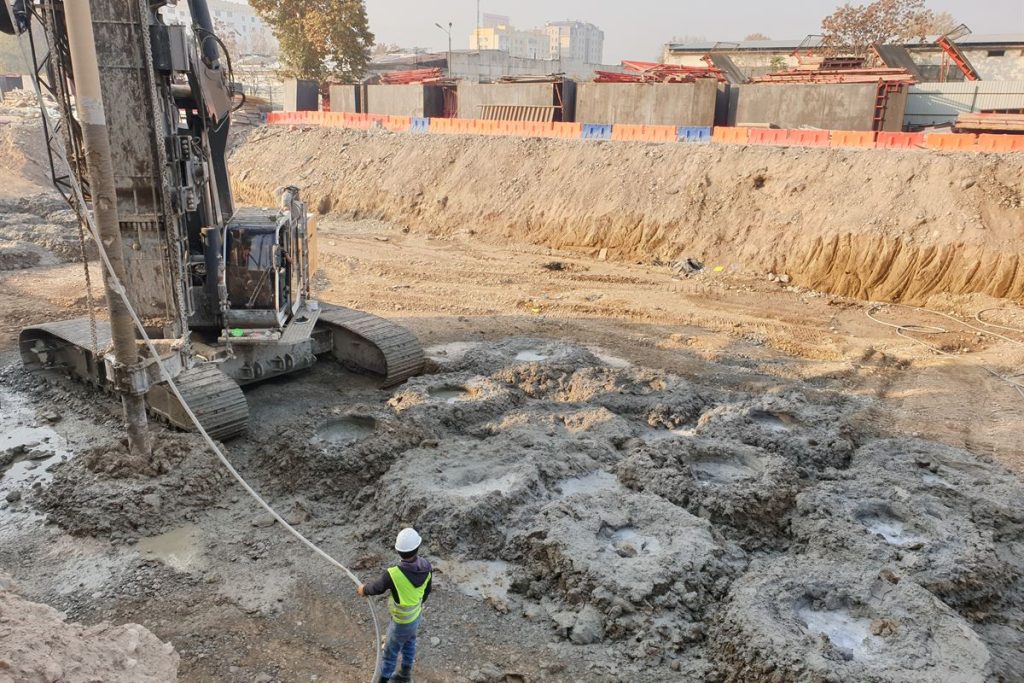
At Fen Zemin we look at DSM, jet grouting and bored piles with the same engineering eye. First we read the site investigation, then we propose the method that fits the purpose.
What does the price of deep soil mixing depend on?
We usually price DSM per metre of column or per cubic metre treated. However, the cost changes with the binder ratio and the ground. That is why we do not publish rates and quote from the quantities instead.
- Column diameter, length, number and total quantity
- Binder type and ratio: cement per cubic metre
- Ground: obstructions, coarse gravel and hard layers
- Working platform and site access
- Trial columns and the tests you need
- Mobilisation: a large rig and silo set-up
What to send for a quote
- Site investigation report, borehole logs and laboratory tests
- Improvement plan with column diameter, length, spacing and number
- Purpose: settlement, liquefaction or a wall
- Site location, size and access
Write to us even if your design is not final yet. We will look at the site investigation and discuss whether DSM or jet grouting suits your site better.
Frequently asked questions about deep soil mixing
We have grouped the questions we receive by who asks them. If yours is not here, call us or write through the quote form.
Buying and cost
How much does deep soil mixing cost per metre?
We do not publish a fixed rate, because the price depends on the binder ratio, the ground and the quantity. Send the site investigation and the improvement plan and we will quote from the quantities.
Is DSM cheaper than jet grouting?
Over large areas and in soft ground, DSM is often cheaper, because it uses less cement and produces less spoil. On small jobs, however, mobilising a large rig can wipe out that advantage.
Why do quotes from different firms differ?
Usually the binder ratio and column layout differ. For example, a quote with less cement per cubic metre looks cheap but may not reach the target strength. Line up the ratio and the tests first, then compare the prices.
Why is mobilisation so expensive?
The DSM rig and silo set-up are large, and moving and assembling them costs a lot. So on small jobs mobilisation takes a larger share, and the quote shows it on its own line.
Project managers and contractors
How many metres of DSM can you build per day?
A single figure would mislead you. The ground, the column length, binder supply and the site layout set the daily output. So we settle the programme after the trial columns.
Will DSM damage nearby buildings?
DSM causes no vibration and works at low pressure. As a result, it carries less risk to neighbouring buildings than jet grouting. Even so, we recommend monitoring buildings close by.
How much space does the rig need?
A DSM rig is large and needs a wide, firm working platform. The silo and mixing plant also need space. That is why jet grouting is often the choice on narrow plots.
Can we combine DSM with bored piles?
Yes. On large projects the piles carry the structure, and DSM reduces settlement of the soft ground around them. The two worked together on the Northern Marmara Motorway and Olmazor projects, where our founder worked.
Site engineers
What do we need to prepare on site?
The rig needs a level working platform that can carry its track loads. Also plan space for the silo, mixing plant, water and power. We set the platform with you for the ground and the rig.
What happens to the column heads?
The top of a column usually stays weaker. So we build the columns a little above working level and then trim off the excess. The design sets the trim level.
What do you do if you hit an obstruction?
Old foundations, large boulders or rubble can stop the mixing tool. In that case we dig out the obstruction or move the column with the designer’s approval.
Supervising engineers and inspectors
How do you test a DSM column?
Coring is the most common method; the laboratory then tests the cores in compression. You can also take samples from the fresh mix. If needed, a load test on a column or a group follows.
Who sets the target strength?
The designer sets the target strength. We then settle the binder ratio with the design team based on results from the trial columns.
Which standard do you work to?
For construction we follow EN 14679 (deep mixing), which Türkiye adopts as TS EN 14679. Designers use TBDY 2018 and Eurocode 7. On public works we also follow the client’s technical specification.
Structural and geotechnical designers
What is the area replacement ratio?
The area replacement ratio is the total area of the columns divided by the treated area. A higher ratio means less settlement but higher cost. So you choose the ratio to meet the target settlement.
Which layout should we choose?
For settlement, a grid of single columns is often enough. Against liquefaction, however, cells or walls of overlapping columns work better. Ground conditions and the seismic design decide the layout together.
Can a DSM wall carry load?
A DSM column has no reinforcement and is weak in tension. So in an excavation wall, steel sections go inside the columns. The steel takes the bending, and the DSM holds back water and soil.
Does DSM work in organic soil?
Organic matter and very high water content make it hard for cement to set. In such ground, laboratory mix tests should guide the choice of binder type and ratio.
Owners and neighbours
Can you build DSM under my building?
Usually not. A DSM rig is large and cannot work under an existing building. For ground under existing buildings, jet grouting or micropiles are the usual choice.
Does DSM help against earthquakes?
DSM can strengthen loose sand and reduce the risk of liquefaction. However, a building’s earthquake resistance does not depend on the ground alone. The building’s structural system also needs its own assessment.
Academics and students
What is the difference between wet and dry mixing?
In wet mixing the binder goes in as grout, which is common in sandy ground. In dry mixing, powdered binder uses the water already in the soil. As a result, the dry method suits very wet soft clays.
Which binders do you use?
Cement is the most common binder. Lime, ground granulated blast-furnace slag and blends of these also work. The ground type and laboratory tests decide the choice.
What is the difference between DSM and CSM?
CSM (cutter soil mixing) is a form of deep mixing that uses cutting wheels to build rectangular panels. DSM, on the other hand, produces round columns with rotating paddles. Both methods mix the soil in place.

Sources
Request a quote for deep soil mixing
Send us your site investigation and improvement plan. We will settle the method, the binder ratio and a quantity-based quote together.