


Services · Excavation support · Soil nailing
Soil Nailing: Soil Nail Walls for Slopes and Excavations
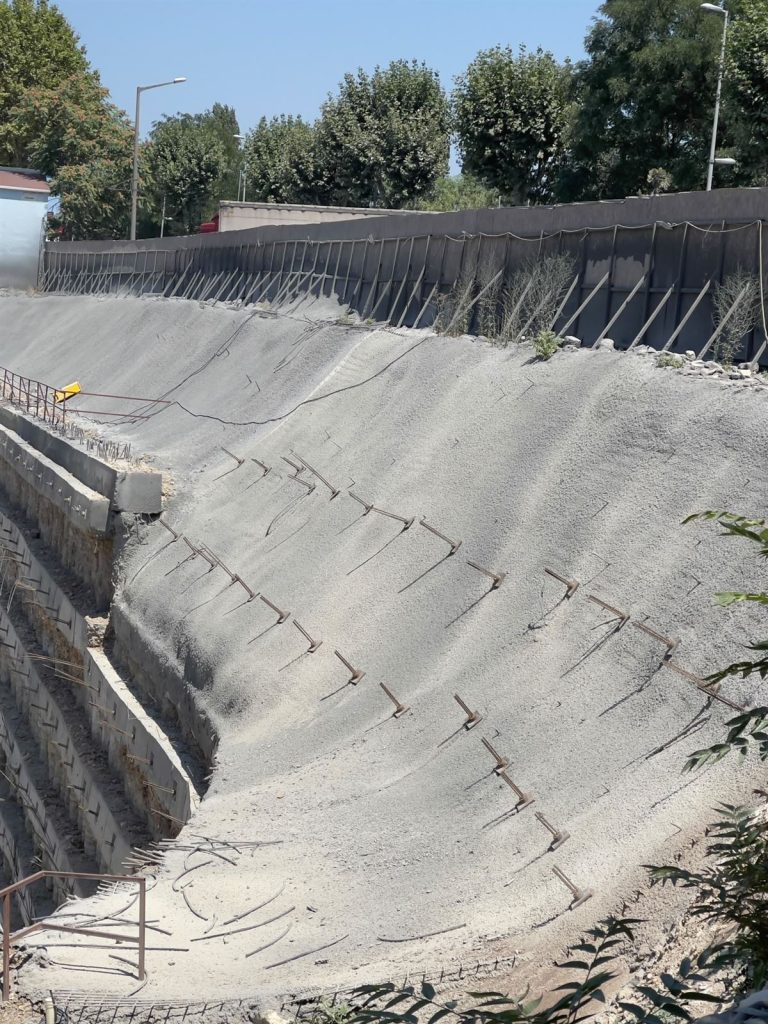
Soil nailing uses steel bars that we drill into the excavation face stage by stage and grout along their full length. Together with a shotcrete facing, the nails strengthen the ground from within and keep the cut standing.
Element
Steel bar, fully grouted
Facing
Mesh-reinforced shotcrete
Excavation
Stage by stage
How it works
Passive; not stressed
Project
Küçükçekmece, 2023
Region
Türkiye and Central Asia
What is soil nailing?
In soil nailing we drill slightly inclined holes into the excavation face, place a steel bar in each and fill the full length with cement grout. We set the nails at close spacing and tie their heads to a mesh-reinforced shotcrete facing. The nailed ground then works as a block that holds back the soil behind it.
The nails are not stressed. Instead, they start to carry load when the ground moves very slightly towards the excavation. That is why a soil nail works differently from a prestressed anchor and goes in at closer spacing.

When does soil nailing suit a site?
- The ground can stand on its own for a short time when you dig one stage
- The excavation is above groundwater, or the water is under control
- Slope and hillside cuts at depths that do not need a pile wall
- An existing slope or an old retaining wall needs strengthening
- The sloped part above a bored pile wall
On the other hand, very loose sand, soft clay and ground below water will not stand up during a stage cut. On such sites we recommend an anchored bored pile wall.
Soil nails or ground anchors?
Both elements use drilling, steel and grout. However, they work in different ways and suit different places.
| Topic | Soil nail | Prestressed anchor |
|---|---|---|
| Prestress | None; works passively | Yes; stressed with a jack |
| Grout | Full length | Bond length only |
| Element | Steel bar | Usually multi-strand |
| Spacing | Close | Wider, with higher loads |
| Facing | Shotcrete | Bored pile wall and waler beam |
| Typical use | Slopes, shallow and medium cuts | Deep cuts, close to neighbours |
In short, soil nailing is a fast and economical solution when the ground suits it. Close to neighbours and in deep, wet excavations, however, prestressed anchors with bored piles are safer. In Küçükçekmece we used both together.
Where do we use soil nailing?
We use soil nailing mostly on slopes and in staged excavations. It also helps strengthen existing structures.
Excavation slopes
Holds a steep slope at the top of a basement dig or in an open cut.
Roads and hillsides
Stabilises the ground in road cuttings and on hillsides.
Above pile walls
Supports the sloped part above a bored pile wall.
Old wall strengthening
Ties existing retaining walls back to the ground behind them.
How do we build a soil nail wall?
We build the wall from the top down, stage by stage. We also never start a new stage before the one above it is complete.

- Staged excavation: We open the cut to a height the ground can hold for a short time.
- Drilling: We drill from the cut face at the angle in the design.
- Nail and grout: We place the steel bar with centralisers and fill the full length by pumping grout from the base.
- Facing: We fix drainage strips and mesh, spray the shotcrete and fit plates on the nail heads.
- Next stage: Once the facing gains enough strength, we dig the stage below.
The most common mistake we see on site: digging a stage deeper than the design allows. The open face can collapse, and the nails above cannot carry the load. That is why we check the stage height every time.
Quality control and pull-out testing for soil nailing
We check quality through installation records and pull-out tests. For example, we record the length, angle and grout volume of every nail. Also, if the design or specification asks for it, we run pull-out tests on test nails.
| Check | What it shows | What it does not show |
|---|---|---|
| Installation record | Length, angle, grout volume | How well the nail grips the ground |
| Pull-out test | Bond between nail and ground | How the whole wall behaves |
| Shotcrete thickness | Whether the facing meets the design | The condition of the ground behind it |
| Movement monitoring | Movement of the wall and neighbouring buildings | The condition of a single nail |
Our soil nailing projects
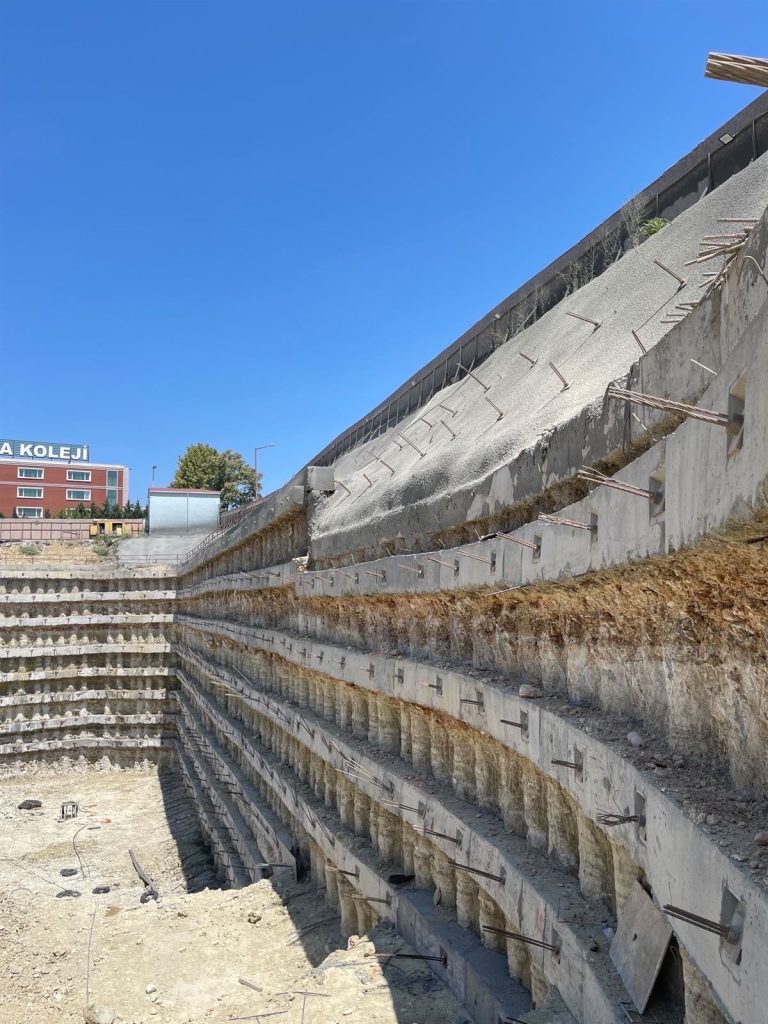
Aydın University Annex Building
A nailed, shotcreted slope at the top of the deep excavation, with a bored pile wall and 800 anchors below it.
On this project we used soil nails in the upper part of the excavation and an anchored bored pile wall in the lower part. This way we built an economical system that suited the ground at every depth.
What does the price of soil nailing depend on?
We usually price soil nailing per metre of nail and per square metre of shotcrete. However, the number of stages and the ground change the pace and the cost. That is why we do not publish rates and quote from the quantities instead.
- Nail length, spacing and total quantity
- Bar diameter and corrosion protection
- Shotcrete thickness and mesh
- Drainage and weep holes
- Number of stages and coordination with the excavation crew
- Pull-out tests and mobilisation
What to send for a quote
- Site investigation report and borehole logs
- Shoring design: nail lengths, spacing and angles
- Excavation depth, slope angle and details of neighbouring buildings
- Site address and target programme
Write to us even if you have no design yet. We will look at the site investigation and discuss whether soil nailing or an anchored wall suits your site.
Frequently asked questions about soil nailing
We have grouped the questions we receive by who asks them. If yours is not here, call us or write through the quote form.
Buying and cost
How much does soil nailing cost per metre?
We do not publish a fixed rate, because the price depends on the ground, the nail length and the number of stages. Send the design and the site investigation and we will quote from the quantities.
Is soil nailing cheaper than anchors?
Usually yes, because there is no stressing or waler beam and the process is simpler. However, you need more nails than anchors. Also, if the ground is not suitable, nails are not an option at all.
Is shotcrete priced separately?
Yes. We usually price shotcrete separately by square metre and thickness. Mesh and drainage also appear on their own lines.
Why do quotes differ?
Usually the scope differs. For example, one quote may leave out the mesh, drainage or pull-out tests. Line up the items first, then compare the unit rates.
Project managers and contractors
How long does a soil nail wall take?
The excavation depth, number of stages and ground set the duration. The next stage cannot start until the one above it is complete. So we draw up the programme together with the excavation crew.
How do you work with the excavation crew?
First the excavation crew opens one stage, then we complete the nails and facing. After that, the dig moves down a stage. We plan this cycle every day.
Can you use soil nailing next to a neighbouring building?
The nails are not stressed, so the wall moves slightly as it works. Next to a sensitive neighbouring building, an anchored wall may therefore be safer. In the end, the design and the monitoring decide.
Site engineers
How high should each stage be?
The ground and the design set the stage height. The rule is that the open face must stand until the nails and shotcrete are in. So in weak ground we keep stages shorter.
What if water comes out of the cut face?
First we lead the water away with drainage strips and weep holes. If there is a lot of water and the ground starts to flow, however, soil nailing may not suit the site. In that case we review it with the designer at once.
When do you spray the shotcrete?
We spray it as soon as possible after placing the nails, without leaving the face open. This way the facing closes before the ground dries out and loosens.
Supervising engineers and inspectors
How do you run a pull-out test?
We pull the test nail with a jack and raise the load in steps. At each step we measure the nail’s movement and note the result. The design also sets the position and number of test nails.
Which standard do you work to?
For construction we follow EN 14490 (soil nailing), which Türkiye adopts as TS EN 14490. Designers use TBDY 2018 and Eurocode 7. On public works we also follow the client’s specification.
Structural and geotechnical designers
What sets the nail length?
Each nail must reach far enough into the ground behind the potential slip surface. The nailed block also needs checks against overturning and sliding, like a wall.
Can you build a permanent soil nail wall?
Yes. A permanent wall, however, needs wider corrosion protection and a more durable facing. FHWA GEC 7 is a detailed guide on this.
Do you propose alternatives?
Yes. For example, a mixed solution with nails above and an anchored wall below can cost less. We prepare such a proposal with our design partner; the designer makes the final decision.
Owners and neighbours
Soil nailing is under way next door. Will my building be affected?
A soil nail wall works by moving slightly. So before work starts, have the condition of your building recorded with photos and a signed report. If you notice a crack, tell the contractor and the building inspection firm in writing.
Will the nails go under my building?
Depending on their length, they can. That is why the design stage should settle this. If you are concerned, ask the contractor and the building inspection firm for information.
Academics and students
Why is a soil nail a passive element?
We install nails without stressing them. Once the ground moves slightly towards the cut, however, the nails start to work in tension. As a result, the nailed ground behaves as a single block.
Are soil nails and rock bolts the same?
They look alike but differ. A rock bolt ties blocks of fractured rock together. A soil nail, on the other hand, strengthens soil and falls under EN 14490.
Why does the facing matter?
The shotcrete facing stops the soil between the nails from falling out. It also spreads the load at the nail heads across the face. So facing thickness and mesh are part of the design too.

Sources
Request a quote for soil nailing
Send us your excavation design and site investigation. We will confirm whether soil nailing suits your site and prepare a quantity-based quote.