


Services · Excavation support · Ground anchors
Ground Anchors: Prestressed Anchors for Retaining Walls
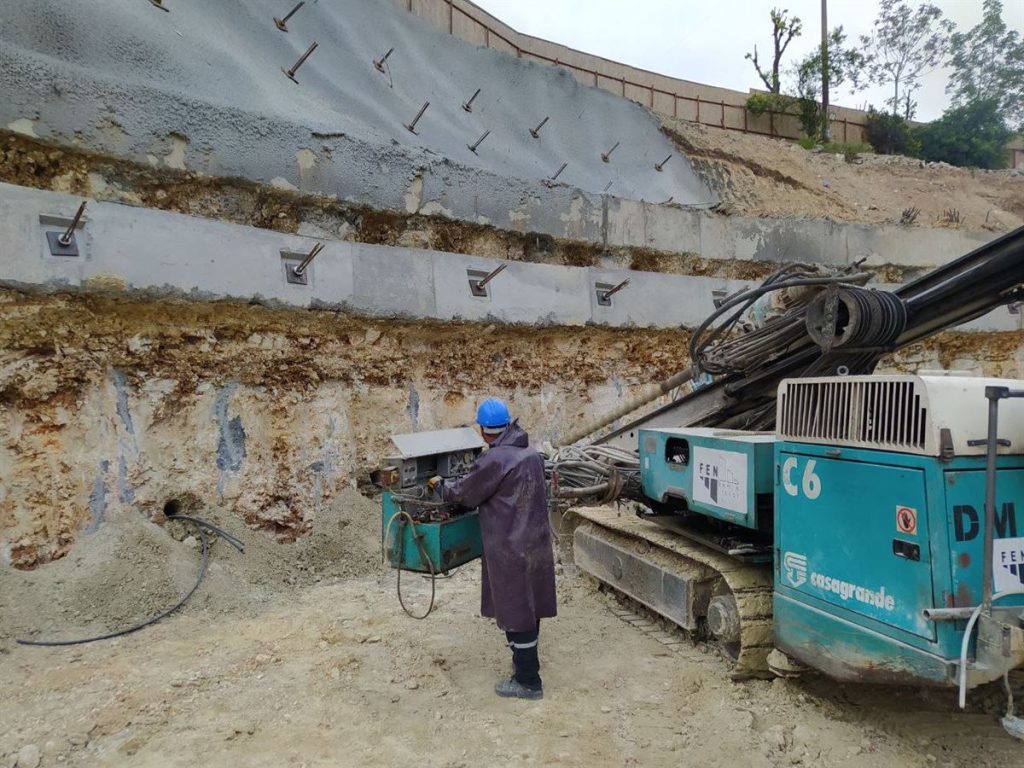
Ground anchors are stressed steel strand tendons that tie a retaining wall back to firm ground behind a deep excavation. We installed 800 ground anchors totalling 30,000 m in Küçükçekmece and about 10,000 m in Tashkent.
Küçükçekmece
800 anchors, 30,000 m
Tashkent
About 10,000 m
Rigs
Casagrande C6, Soilmec SM14
Type
Temporary and permanent, strand
Supported excavation
Up to 30 m deep
Region
Türkiye and Central Asia
What are ground anchors?
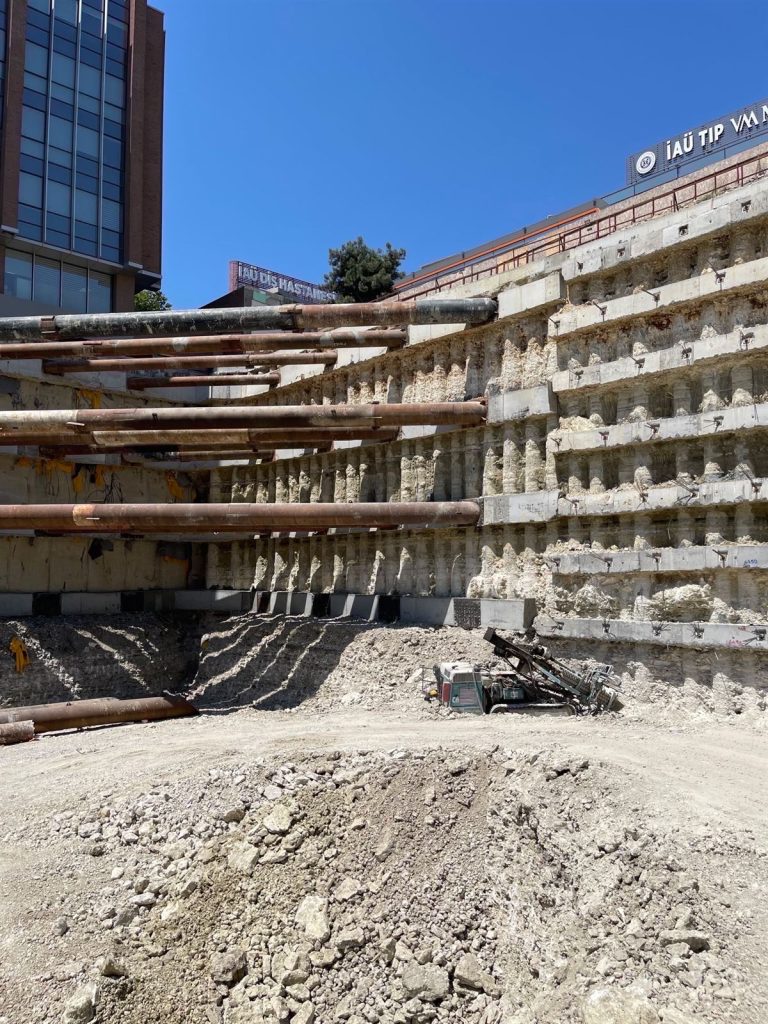
A ground anchor is a support element: we drill an inclined hole from the excavation face, place a steel strand tendon in it and grout the far end. Once the grout hardens, we stress the tendon with a jack and lock it off at the head. The wall is then tied to the ground behind it.
Every anchor has two parts. Along the free length the tendon runs inside a sheath and passes no load to the ground. Along the bond length, by contrast, the grout locks the tendon into the ground and carries the load. So the bond length must sit in firm ground behind the potential slip surface.

When do you need ground anchors?
- The excavation gets too deep for the wall to work as a cantilever
- Struts inside the excavation would get in the way of the work
- Movement of neighbouring buildings and roads must stay within limits
- A slope or landslide needs the moving mass held in place
- A structure needs holding down against groundwater uplift
Temporary or permanent anchors?
Most anchors in basement excavations are temporary. On slopes and retaining walls, however, anchors work for the life of the structure. This difference changes the corrosion protection and the testing.
| Topic | Temporary anchor | Permanent anchor |
|---|---|---|
| Service life | During construction | For the life of the structure |
| Corrosion protection | Limited | Double protection: sheath and grout |
| Typical job | Basement shoring | Slopes, retaining walls, uplift |
| Testing | Acceptance test | Wider testing and long-term monitoring |
The design decides whether an anchor is temporary or permanent. Also, if an anchor will pass under the neighbouring plot, the design stage should settle this. Soil nails, which are not stressed and are grouted along their full length, work differently.
Where do we use ground anchors?
We use anchors most often in bored pile shoring. They also work on slopes, retaining walls and against uplift.
Bored pile shoring
Support the wall in one or more rows in a deep basement dig.
Slopes and landslides
Tie a moving mass to firm ground, together with soil nails and shotcrete.
Retaining walls
Stop tall walls from overturning and sliding.
Uplift
Hold foundations and pools below groundwater against buoyancy.
How do we install ground anchors?
Each anchor takes five steps. Meanwhile the excavation goes down in stages, row by row.

- Staged excavation: We dig down to just below the anchor level. The rig works from this bench.
- Drilling: We drill through the wall at the angle in the design. If the hole could collapse, we advance with casing.
- Tendon and grout: We place the tendon in the hole and pump cement grout from the base. This way the bond length locks into the ground.
- Stressing: Once the grout gains enough strength, we fit the waler beam and the head and stress the tendon to the test load with a jack.
- Lock-off: We bring the anchor to the lock-off load in the design and lock it with wedges. Then the excavation moves on to the next stage.
The most common mistake we see on site: stressing an anchor before the grout has hardened enough. The bond length then does not grip the ground fully and the anchor slips. That is why we plan stressing days around the grout strength.
Stressing tests and quality control of ground anchors
Every anchor goes through an acceptance test: we stress it with a jack, raise the load in steps and measure how far the tendon extends. If the result meets the criteria, we bring the anchor to the lock-off load in the design and lock it.
| Check | What it shows | What it does not show |
|---|---|---|
| Drilling record | Length, angle and the layers passed | How well the bond length grips the ground |
| Grouting record | Volume of grout used | Bond length capacity on its own |
| Acceptance test | That the anchor holds the test load | Long-term behaviour in full |
| Monitoring | Movement of the wall and neighbouring buildings | The condition of a single anchor |
We recommend measuring wall and neighbour movement throughout the excavation. Permanent anchors also need long-term monitoring.
Our ground anchor projects
Aydın University Annex Building
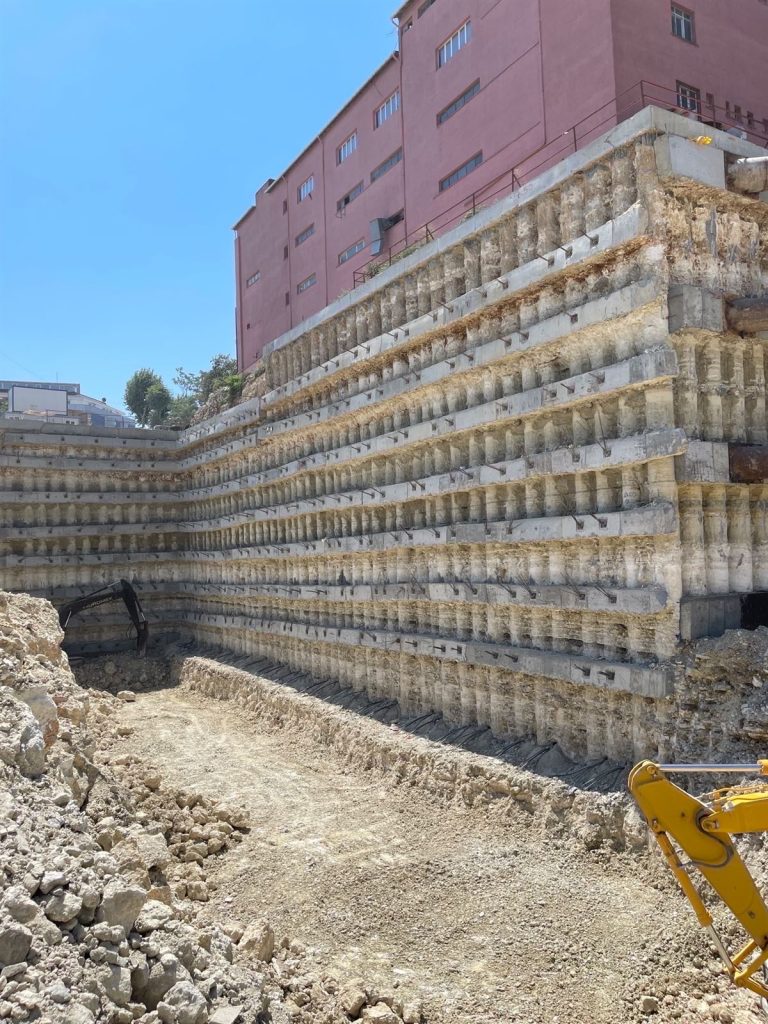
800 anchors, 30,000 m in total, and 200 bored piles of Ø80 cm. We delivered long anchors in clay on time.
Tashkent residential and commercial projects
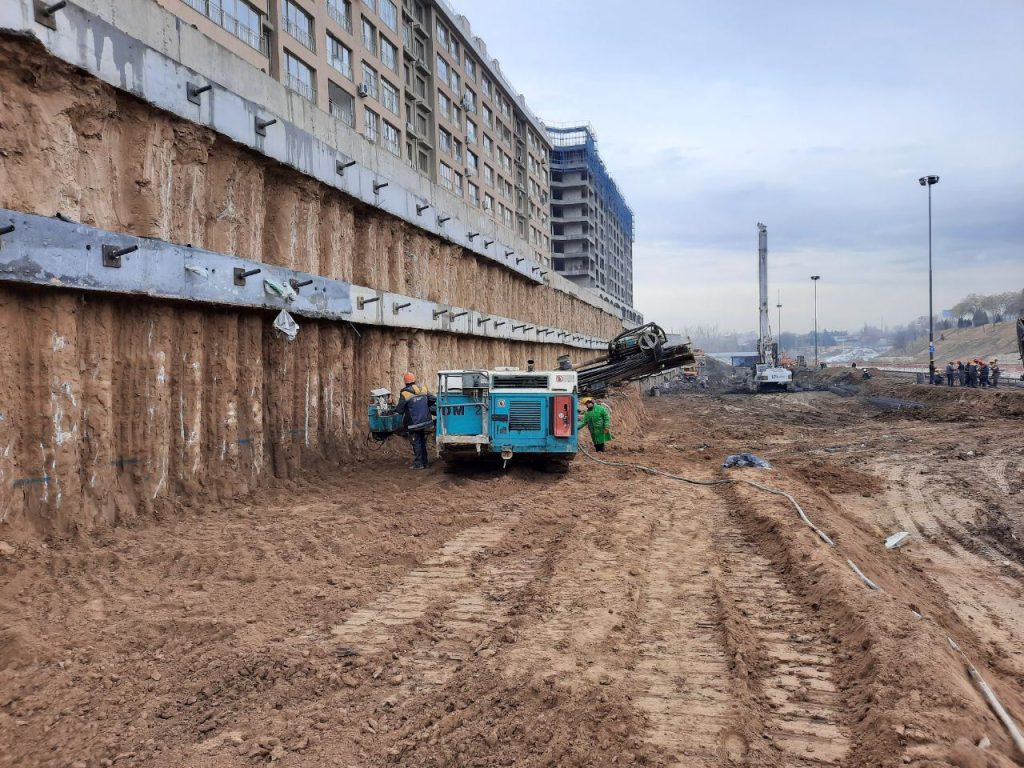
About 10,000 m of anchors on the Metropol, Pushkin, Befit and Seoul projects. Spare parts were hard to find, yet the work never stopped.
Our founder, Abdullah Çetintaş, also worked on anchored shoring in earlier roles. Examples include the Trilliant Hotel in Uzbekistan and the TCDD Adana–Mersin railway line. See our founder’s earlier projects.
What does the price of ground anchors depend on?
We usually price anchors per metre. However, even for the same length, the number of strands, the ground and the testing change the cost. That is why we do not publish rates and quote from the quantities instead.
- Anchor length, number and total quantity
- Number of strands and design load
- Ground: the need for casing or rock drilling
- Temporary or permanent; corrosion protection
- Waler beam, heads and stressing tests
- Excavation stages, rig bench and mobilisation
What to send for a quote
- Site investigation report and borehole logs
- Shoring design: anchor rows, lengths, angles and loads
- Excavation depth and details of neighbouring buildings
- Site address and target programme
Write to us even if some documents are missing. We make an initial assessment from what you have and fill the gaps together. Also, if you need a shoring design, we can have one prepared with our design partner.
Frequently asked questions about ground anchors
We have grouped the questions we receive by who asks them. If yours is not here, call us or write through the quote form.
Buying and cost
How much do ground anchors cost per metre?
We do not publish a fixed rate, because the price depends on the number of strands, the ground and the quantity. Send the shoring design and the site investigation and we will quote from the quantities. Our quote shows drilling, strand, grouting and stressing on separate lines.
Who supplies the strand?
We agree at quote stage who buys the strand and other materials and state it clearly in the quote. In every case we check the strand type and number against the design.
Is the waler beam included?
The waler beam can be steel or reinforced concrete, and this changes the quote. So we show on a separate line who is responsible for the waler.
Why do quotes from different firms differ so much?
Usually the scope differs. For example, one quote may leave out the waler beam, casing or stressing tests. Line up the items first, then compare the unit rates.
Project managers and contractors
How long does anchoring take?
The number of anchors, their length, the ground and the excavation stages set the duration. The next dig cannot start until each row is complete. So with the quote we provide a programme tied to the excavation sequence.
How do you work with the excavation crew?
Once the dig reaches just below the anchor level, the anchor crew moves in. When stressing is complete, the dig moves to the next stage. We plan this sequence with the earthworks crew every day.
What if an anchor passes under the neighbouring plot?
The length and angle of an anchor can take it under the neighbouring plot. The design stage should settle this, and if needed you should reach an agreement with the neighbour. Temporary anchors can also be de-stressed once the work is done.
Will anchoring damage the building next door?
Anchors protect the building next door by limiting wall movement. Risk arises, however, if the ground loses material during drilling. So where needed we drill with casing and recommend monitoring the neighbouring building.
Do you work outside Türkiye?
Yes. We installed about 10,000 m of anchors on residential and commercial projects in Tashkent. Spare parts were hard to find on that site, yet our crew solved problems with its own means and the work never stopped.
Site engineers
How wide should the bench be?
The bench must be wide enough for the anchor rig to work comfortably. We set the width with you for the rig and the anchor angle. The bench also needs to be firm enough to carry the rig.
When do you stress the anchors?
We stress once the grout has gained enough strength. The grout mix and the design set this time. If someone took strength samples, for example, we confirm the stressing day from the results.
When can the excavation continue?
Nobody should dig below a row until every anchor in it is stressed and locked off. This rule keeps the wall from moving too much. We get sign-off with the supervising engineer at every stage.
Supervising engineers and inspectors
How do you run a stressing test?
We raise the load with the jack in steps and measure the tendon extension at each step. We also hold the load at set levels and check that the extension stays stable. The results go into a record for every anchor.
What is the lock-off load?
The lock-off load is the load at which we lock the anchor with wedges after the stressing test. The design sets this value. There is a small loss after lock-off, so the design allows for it.
Which standard do you work to?
For installation and testing we follow EN 1537 (ground anchors), which Türkiye adopts as TS EN 1537. Designers use TBDY 2018 and Eurocode 7. On public works we also follow the client’s technical specification.
Structural and geotechnical designers
Why is a free length needed?
The free length moves the bond length behind the potential slip surface. In this way the anchor load goes into firm ground, not into the moving mass. The free length also spreads the prestress along the tendon.
What sets the anchor angle?
The depth of the firm layer, neighbouring foundations and buried services set the angle. A steeper angle takes the bond length deeper, but it adds vertical load to the wall. So each project needs its own choice of angle.
How do you protect permanent anchors from corrosion?
Permanent anchors get double protection: a sheath and grout. The head zone also gets its own protection. EN 1537 and the design decide which protection the anchor needs.
Can internal struts replace anchors?
In narrow, shallow excavations, internal struts are an option. In wide excavations, however, struts get in the way of digging and building. We make the choice with you from the excavation geometry and the neighbours.
Owners and neighbours
Will the anchors from the site next door go under my building?
They can; the anchor length and angle may take them there. The design stage should settle this. If you are concerned, ask the contractor and the building inspection firm for information.
What happens to temporary anchors afterwards?
A temporary anchor has done its job once the basement walls take the load. The strands and the bond length, however, usually stay in the ground. So anyone digging in that area later needs to know where the anchors are.
Academics and students
What is the difference between ground anchors and soil nails?
Ground anchors are prestressed and have a free length and a bond length. Soil nails, by contrast, are not stressed and are grouted along their full length. Also, a nail picks up load as the ground moves, while an anchor carries load from the start.
Why prestress an anchor?
Prestress loads the anchor before the wall starts to move. As a result, the wall and neighbouring buildings move less during the excavation.
How does the bond length carry load?
The grout in the bond length creates friction and interlock with the ground. The load passes into the ground along this contact surface. So the denser the ground, the shorter the bond length can be.
Why do anchors lose prestress?
During lock-off the wedges slip slightly. Over time, the strand also relaxes and the ground creeps. The design allows for these losses.

Sources
Request a quote for ground anchors and shoring
Send us your site investigation and shoring design. We will prepare a work plan tied to the excavation programme and a quantity-based quote together.