

Knowledge Centre · Guide · Shoring cost
7 Ways to Reduce Shoring and Piled Foundation Costs
Shoring cost is usually set at the design desk, not on site. In this guide we describe seven ways to cut the cost of shoring and piled foundations without giving up safety, with examples from our own sites.
Topic
Shoring and foundation cost
Reading time
About 7 minutes
Written by
Abdullah Çetintaş, Geological Engineer
Updated
November 2026
Related services
Bored piles, anchors, soil nailing
Example
Küçükçekmece mixed shoring
Where does shoring cost come from?
First of all, a shoring system’s cost has several parts: pile quantities, anchors or props, the capping beam, shotcrete, monitoring and mobilisation. In addition, the excavation programme and how long the rig stays on site directly affect the total.
That is why the biggest saving lies before construction, at the design stage. After all, once you cast a pile, you cannot change its length or the number of piles.
How can shoring cost come down? 7 safe ways
1. A proper, sufficient site investigation
To begin with, shallow or incomplete boreholes force the designer to choose cautious parameters. As a result, piles and anchors come out longer than they need to be. By contrast, an investigation that goes deeper than the excavation and the piles often pays back more than it costs.
2. The right shoring system
Of course, not every excavation needs an anchored bored pile wall. For example, a cantilever wall in a shallow dig, or soil nailing in suitable ground, can cost far less. However, a neighbour close by or groundwater calls for a stiffer system.

3. Mixed solutions
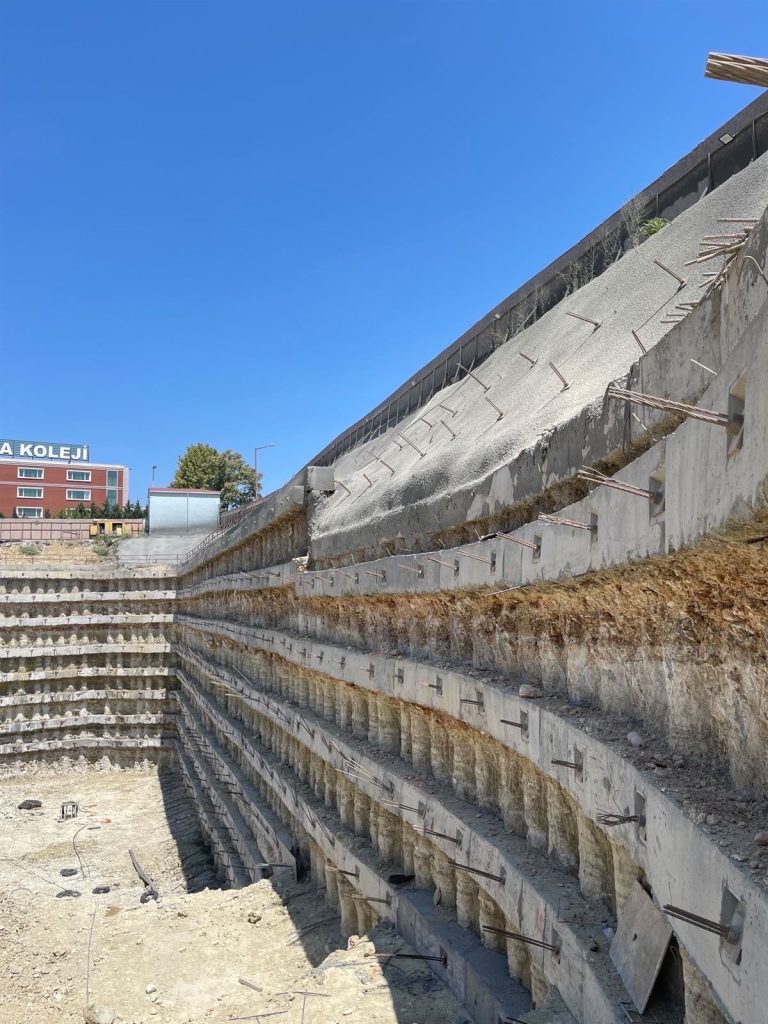
Besides, you do not have to use the same system at every depth. In the deep excavation in Küçükçekmece, for instance, we used a soil-nailed slope in the upper part and an anchored bored pile wall below; in this way, we built an economical system that suited the ground at each depth.
4. Pile layout and diameter
In general, without groundwater, contiguous piles with shotcrete are usually enough. Secant piles, on the other hand, are only necessary to cut off water, because they need far more quantity.

5. Anchor rows and lengths
Similarly, the number of anchor rows, their spacing and their length set the quantity directly. So the designer sometimes finds a cheaper layout with fewer rows of higher-capacity anchors, or the reverse.
6. Using the wall in the permanent structure
Furthermore, shoring and foundations are usually separate designs, but they must fit together. For example, the pile wall can also serve as the outer formwork for the basement wall.
7. Programme and site layout
Above all, every day the rig stands idle costs money. Therefore, we plan the sequence with the excavation crew, the concrete logistics and the working platform before work starts.
Summary: what does each way save?
| Way | What it saves | Watch out for |
|---|---|---|
| Sufficient site investigation | Shorter piles and anchors | Boreholes should go below the pile toes |
| The right system | Avoids needless stiffness | Neighbours and water decide |
| Mixed solution | A suitable system at each depth | Design the transition zone well |
| Contiguous piles | Less quantity | Only without groundwater |
| Optimised anchors | Fewer anchor metres | The designer makes the call |
| Wall in the permanent structure | Saves formwork and space | Must fit the foundation design |
| Programme | Rig and crew never wait | Daily coordination with the excavation crew |
What should never be cut when shoring cost comes down?
Indeed, some items look like savings but end up costing far more. For this reason, we never negotiate on the following.
- Pouring through a tremie pipe in any bore that holds water or bentonite
- Stressing and acceptance tests on anchors
- A condition survey of adjacent buildings and monitoring throughout the excavation
- Excavating in the stages set out in the design
We cover these points in detail in our guide to common site mistakes.
Frequently asked questions about shoring cost
We have collected the questions about shoring cost that we hear most often. However, if yours is not here, call us or write through the quote form.
Cost and proposals
What does shoring cost per square metre?
We do not publish a fixed price. That is because a shoring price is made up of pile metres, anchor metres, the capping beam, shotcrete and monitoring, and these change on every project.
Which shoring system is the cheapest?
In short, there is no single answer. For example, soil nailing is usually the most economical in suitable ground; however, a neighbour close by or groundwater calls for an anchored or secant pile wall.
Are internal props cheaper than anchors?
They can be in narrow, shallow excavations. On the other hand, in wide excavations props get in the way of digging and building; consequently, they can raise the total cost.
Who approves the changes you propose?
Always the designer. We prepare proposals with our design partner based on our site experience; however, the final decision belongs to the designer.

Let us review your shoring cost together
First, send us your site investigation and architectural drawings. Then let us look, together with our design partner, at whether a more economical shoring layout is possible.