


Knowledge Centre · Field Notes · Excavation below sea level
Dry Excavation 4 m Below Sea Level: Karaköy
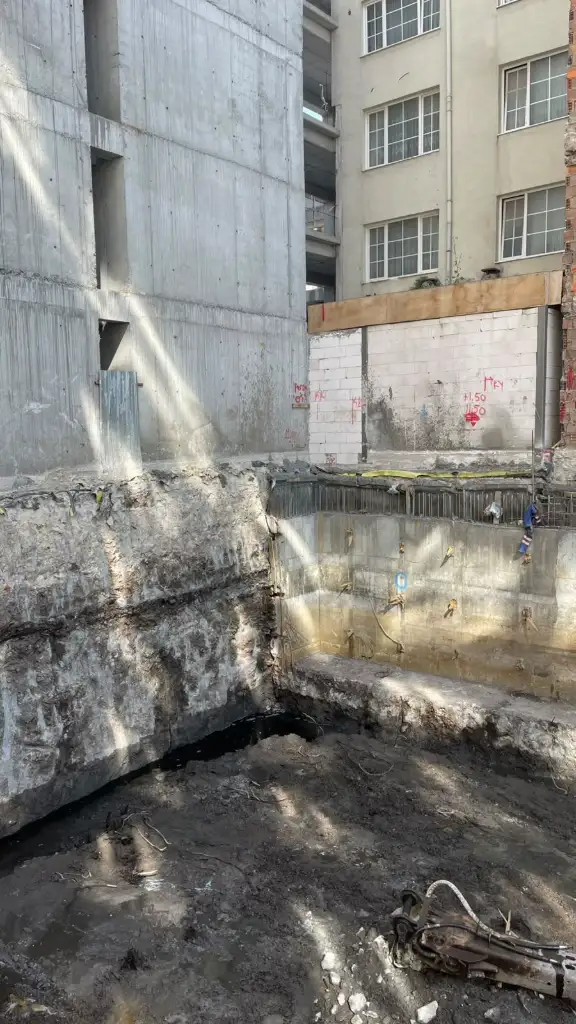
On a waterfront plot in Karaköy, the foundation level sat about 4 m below sea level. We enclosed the excavation with secant bored piles and sealed the ground below the foundation with jet grouting before digging. When we opened the excavation, the base was dry.
Series
Site Cases
Location
Karaköy, Beyoğlu, Istanbul
Year
2024
Foundation level
About 4 m below sea level
Secant bored piles
100 piles, Ø65 cm, 1,200 m
Jet grouting
800 columns, Ø80–100 cm, 8,000 m
Excavation below sea level: summary
In short: in an excavation below sea level, water comes in not only from the sides but also through the base. In Karaköy we closed the sides with a secant bored pile wall and the base with jet grout columns built before digging. As a result, the foundation was built in a dry excavation.
The job was an office building project in Karaköy. We carried out the shoring and ground improvement for the main contractor, Sam İnşaat. The quantities and site photos are on our Karaköy project page.
The problem: excavation below sea level on a waterfront plot
The plot was right on the waterfront, and the foundation level was about 4 m below sea level. At this depth, groundwater enters an excavation in two ways: between the piles of the wall, and around the toe of the wall and up through the base.
So a retaining wall on its own would not have been enough. The wall holds the sides; however, if the base is left open, water still comes into the excavation. On top of that, the streets were narrow and we could only work between 10:00 and 17:00.
The first half of the solution: a secant bored pile wall
We enclosed the excavation with a wall of 100 secant bored piles, Ø65 cm, 1,200 m in total. In a secant wall, neighbouring piles cut into each other, so there is no gap along the wall for water to pass.
In a tangent wall, by contrast, the piles only touch; water and fines can come through the joints. We show the types of pile wall with drawings on our bored piles page.
The second half: jet grouting before digging, with empty boring
Below the foundation we built 800 tangent jet grout columns of Ø80 and Ø100 cm, 8,000 m in total. We did this from the original ground level, before excavation started.
We used empty boring: the drill went down to the target depth, we formed the columns only at the depth below the foundation, and we passed through the upper part as an empty bore. In this way, a base that cuts off water was in place below the foundation before the excavation was opened.
As a result, when we opened the excavation, the ground below the foundation was watertight and the base stayed dry.
Quality control: PIT testing and cores
We checked pile integrity with PIT testing, and the jet grout columns with cores taken from the columns. We explain what these tests show in our pile testing guide.
Narrow streets and limited working hours
The streets leading to the site were narrow and we could only work between 10:00 and 17:00. Because of this, daily output dropped. We planned the concrete pours in advance with the necessary permits and delivered the job on time.
Note from site: the key step in an excavation below sea level
What we learned on this job: in an excavation below sea level, sealing the ground below the foundation before digging matters as much as the wall. If you try to seal the base after the excavation is open, the work is done in water.
The foreman of the crew that came on site after us said this while breaking down the columns: “I have been doing this a long time, and I have never seen jet grout work this good. It made our job much easier.”
Questions about excavation below sea level
Short answers to the questions we hear most about this job.
Excavation and shoring
What does empty boring mean?
The drill goes down to the target depth and the jet grout column is formed only at the required depth. The upper part is passed as an empty bore, so no unnecessary column is built in the zone that will be excavated.
What is the difference between secant and tangent piles?
In a secant wall, neighbouring piles cut into each other and form a watertight wall. In a tangent wall, the piles only touch; water and fines can come through the joints.
Why is the base sealed before digging?
If you try to seal the base after the excavation is open, the work is done in water. Jet grouting done before digging keeps the base dry while the excavation is opened.

Digging next to the sea or below the water table?
Send us your site investigation and drawings. Then we can plan the wall and the base together and prepare a quote based on quantities.