

Knowledge Centre · Guide · Protecting adjacent buildings
Protecting Adjacent Buildings in Deep Excavations
Protecting adjacent buildings is the most sensitive part of any basement excavation. In this guide we explain what puts neighbours at risk, how to choose the right shoring, which survey to carry out before work starts and how to monitor during the dig.
Topic
Deep excavations and adjacent buildings
Reading time
About 8 minutes
Written by
Abdullah Çetintaş, Geological Engineer
Updated
November 2026
Related services
Bored piles, anchors, jet grouting
Example
Küçükçekmece, 800 anchors
Why are adjacent buildings at risk in a deep excavation?
When you open an excavation, the soil at its edge loses lateral support. However strong the retaining wall is, it moves a little, and that movement reaches the foundations next door. Yet wall movement is not the only risk.
- Wall movement: as the wall moves towards the excavation, the soil behind it settles.
- Lowering the groundwater: as water drains away, soft layers compress and the neighbouring building can settle.
- Ground loss during drilling: if an unsupported bore collapses, a void forms behind the wall.
- Vibration and pressure: driven-pile vibration or uncontrolled jet grout pressure can cause damage.
- Over-excavation: digging deeper than the design stage loads the wall all at once.
Which shoring works best for protecting adjacent buildings?
The closer and more sensitive the neighbouring building, the stiffer the wall must be. For this reason, excavation depth, ground, water and the depth of the neighbour’s foundation decide the system together.

| System | For the neighbour | When? |
|---|---|---|
| Cantilever pile wall | Moves more at the top | Shallow excavation, firm ground |
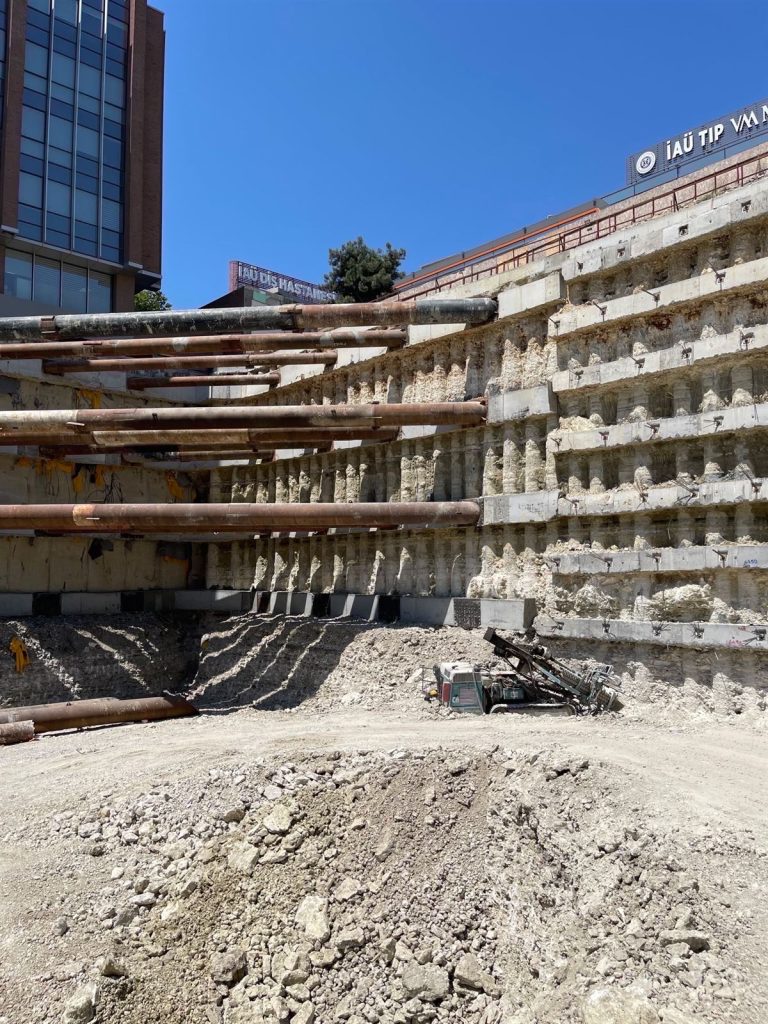
| Anchored bored pile wall | Prestress limits movement | Deep excavation, neighbour close by |
| Propped wall | Stiff; no anchors under the neighbour | Narrow excavation, or anchors not possible |
| Secant piles and jet grouting | Cuts off water, so less dewatering | High groundwater |
| Soil-nailed wall | Works by moving | Away from neighbours, suitable ground |
In Küçükçekmece, for example, we used a bored pile wall with many rows of prestressed anchors in clay. In Karaköy, on the other hand, the groundwater led us to secant piles with a jet grout base.
A condition survey of the neighbouring building before excavation
Recording the condition of the neighbouring building before excavation protects both the neighbour and the project. After all, only that record can show whether a crack you notice later was already there.
- Photos and a signed record: we document the facade, the basement and existing cracks with dates.
- Foundation details: where possible, we find out the depth and type of the neighbour’s foundation.
- Monitoring points: we set up settlement and crack monitoring points before excavation.
- Baseline readings: we record starting values at every point.
Our advice: have the client, the contractor and the neighbour sign the survey together. That way, you head off disputes before they start.
Protecting adjacent buildings: measuring and monitoring
Monitoring shows whether the wall and the neighbouring building behave as the design predicts. In addition, if a movement approaches its limit, it buys you time to act.
| Measurement | What it shows | How often? |
|---|---|---|
| Settlement points | Vertical movement of the neighbouring building | Regularly, by excavation stage |
| Crack gauges | Whether existing cracks are opening | Throughout the excavation |
| Wall-top survey | Horizontal movement of the wall | At every excavation stage |
| Inclinometer | Wall movement with depth | If the design calls for it |
The shoring design sets the frequency and the trigger values. On site, however, we also follow one rule of our own: we never dig to the next stage until the anchors in a row are stressed and locked off.
What should you do if a deep excavation opens next door?
As a neighbour, you can take steps too. In particular, a few steps at the start make it much easier to solve problems later.
- Before the dig starts, have your building’s condition recorded with photos and a signed record.
- Ask the contractor about the shoring system and whether the anchors will run under your building.
- If you see a new crack during the excavation, take a dated photo.
- Notify the contractor and the building inspection firm in writing straight away.
For legal matters, however, we recommend that you consult a lawyer. We cover the technical side: shoring, measurement and monitoring.
Protecting adjacent buildings: frequently asked questions
We have collected the questions about neighbouring buildings that we hear most often. However, if yours is not here, call us or write through the quote form.
Neighbours and clients
Which shoring system does the least harm to neighbours?
Usually a prestressed anchored or propped pile wall, because these systems limit wall movement. Even so, the ground, the water and the excavation depth decide the right choice together.
What happens if anchors run under the neighbouring plot?
The length and angle of an anchor can take it under the neighbouring plot. For this reason, settle the matter at the design stage and, if necessary, reach an agreement with the neighbour; for the legal side, consult a lawyer.
Do bored piles cause vibration?
We build bored piles by drilling, so vibration is low compared with driven piles. Still, the risk next to an adjoining building is not zero; that is why we recommend a survey and monitoring.
Does pumping groundwater affect the building next door?
It can, because soft layers compress as the water level drops. Therefore, in high groundwater, cutting off the water with secant piles and a jet grout base is often safer than pumping it.
How long does monitoring last?
Usually throughout the excavation and until the basement walls take the load. In the end, the shoring design and the readings decide the exact period.

A shoring and monitoring plan for your excavation
Send us your site investigation and design. Then let us agree the shoring system and the monitoring plan that protect the buildings around you.