


Knowledge Centre · Guide · Soil nails or ground anchors
Soil Nails or Ground Anchors? Differences and How We Choose
Whether to use soil nails or ground anchors depends on the excavation depth, the ground, groundwater and the building next door. We build both with drilling, steel and grout, but they work very differently. This guide explains the difference and how we decide on site.
Topic
Choosing a shoring method
Reading time
About 6 minutes
Author
Abdullah Çetintaş, Geological Engineer
Updated
November 2026
Source
FHWA GEC 4 and GEC 7
Example
Küçükçekmece: both together
The main difference between soil nails and ground anchors
From the outside the two elements look alike. However, they work differently and suit different places.
| Item | Soil nail | Prestressed ground anchor |
|---|---|---|
| Prestress | None; passive | Yes; stressed with a jack |
| Grout | Full length | Bond length only |
| Element | Steel bar | Usually multi-strand |
| Spacing | Close | Wider, with higher load |
| Facing | Shotcrete | Bored pile wall and waling beam |
| Typical use | Slopes, shallow and medium cuts | Deep excavation, near neighbours |
In short, a nail strengthens the ground by stitching it into one mass. An anchor, on the other hand, ties the wall back to firm ground and transfers the load in advance.
Soil nails or ground anchors: why does movement decide?
The most important difference is displacement. We do not stress a nail, so it only takes load once the ground moves slightly towards the excavation. We stress an anchor with a jack before the excavation goes deeper. As a result, the wall takes the load without much movement.
So if a neighbouring building is sensitive to cracking, this difference often decides the matter alone. In addition, you need a photo and written record of the neighbouring building before work starts. Our guide to protecting adjacent buildings has the details.
When are soil nails enough instead of ground anchors?
We consider soil nailing when these conditions all apply:
- The ground stands for a short time while we open each stage
- Groundwater is below the excavation base
- The excavation is shallow or medium deep
- No movement-sensitive structure is close by
- The nails stay inside the plot
Under these conditions soil nailing is fast and economical, because it needs no bored pile wall. However, a stage will not stand in loose, wet sand. For that reason, we do not recommend nails in such ground.
Ground anchors where soil nails are not enough
- The excavation is deep
- A neighbouring building is close to the wall
- Groundwater enters the excavation
- The ground does not stand in stages
In these cases we first build a bored pile wall. Then, as the excavation advances, we install prestressed ground anchors row by row. We stress every anchor and carry out its acceptance test. For example, in Küçükçekmece we supported a wall of 200 Ø80 cm piles with 800 anchors.
Both in the same excavation
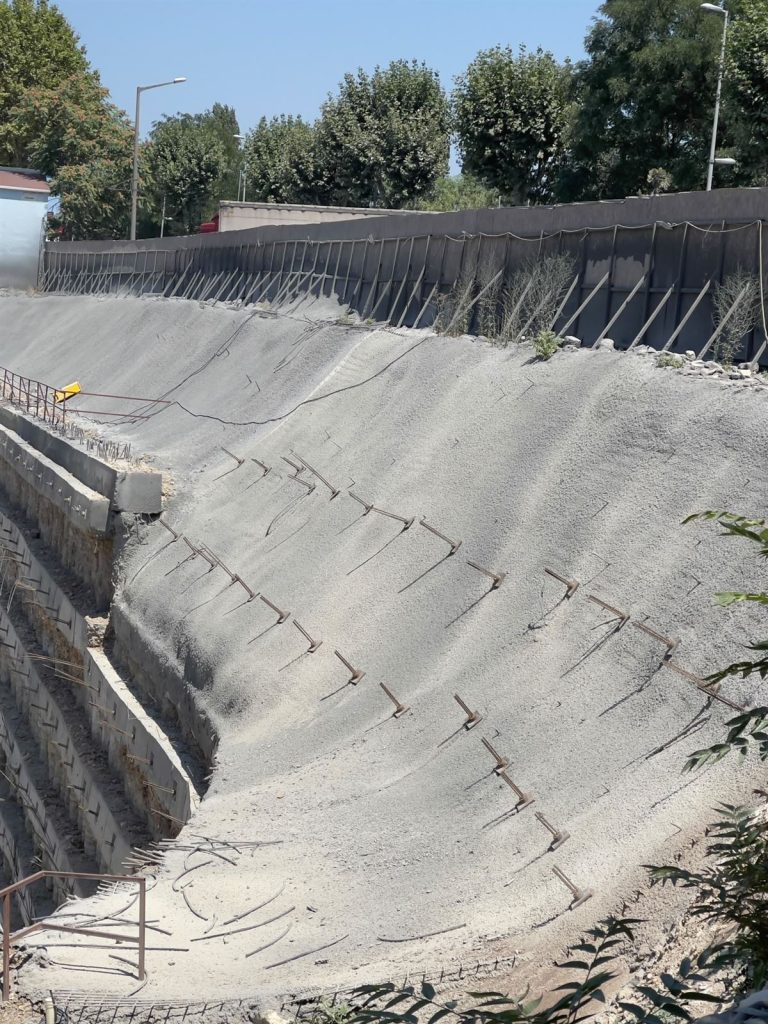
The two methods are not rivals. In Küçükçekmece we used a soil-nailed slope and an anchored bored pile wall in the same excavation. That is because the ground and the neighbours were not the same on every side of the plot.
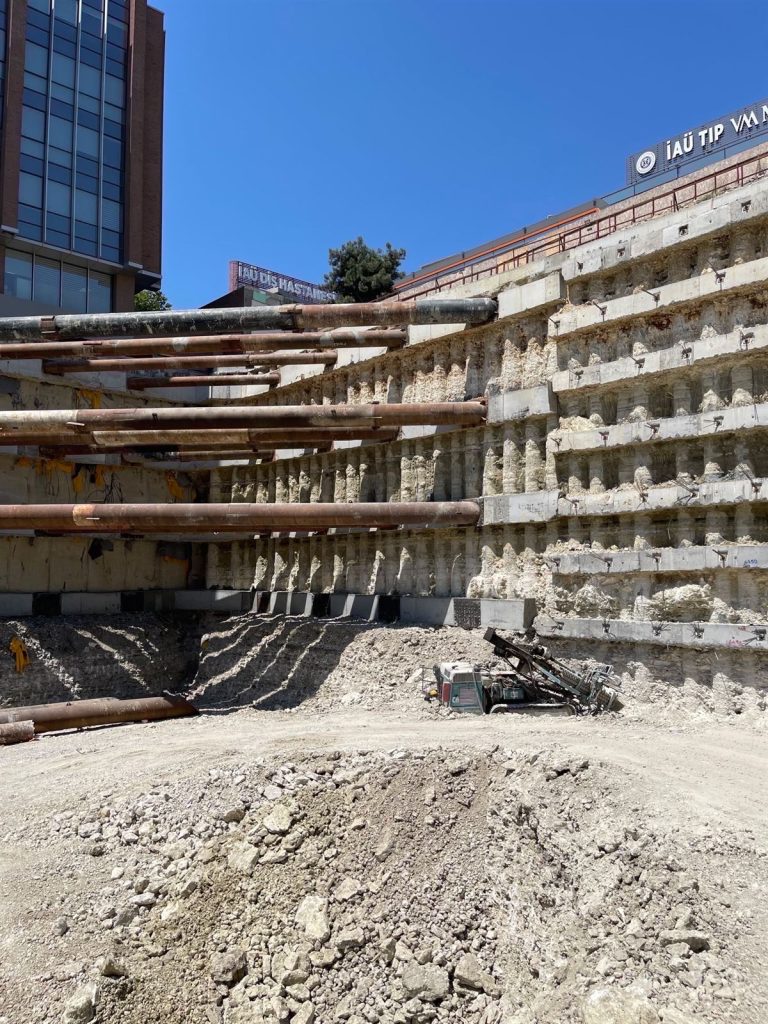
Such mixed solutions often lower the cost as well. You can find examples in our guide to shoring costs.
If they go under the neighbouring plot
Legal point: If a nail or anchor goes under the neighbouring plot, you need the neighbour’s consent. The permission and liability side of this is a legal matter, so we recommend that you consult a lawyer.
For this reason, we check the plot boundary and the element lengths together before the design. If the neighbour does not agree, we look at shorter elements or internally braced solutions. Our guide to tight urban plots has more.
Soil nails or ground anchors: frequently asked questions
We have collected the questions we hear most often about these two methods. If yours is not here, however, call us or use the quote form.
Cost and construction
Are soil nails cheaper than anchors?
Usually yes in suitable ground, because they need no bored pile wall. However, in unsuitable ground the cheap option becomes expensive.
How deep can you go with soil nails?
There is no single limit. The ground, water and neighbours decide, so the design engineer shows it by calculation.
Do you stress the nails afterwards?
No, nails are not prestressed. Anchors, by contrast, we stress one by one and test for acceptance.
Are anchors temporary or permanent?
Both are possible. However, a permanent anchor needs more extensive corrosion protection.
Can a soil-nailed wall damage the neighbouring building?
Not in the right ground and with the right stages. However, nails work with slight movement, so next to a sensitive neighbour we prefer an anchored wall.

Sources
Let us choose the right system for your excavation
Send us the site investigation, the excavation depth and details of the neighbouring buildings. Then we can review nails, anchors or a mixed solution together.
