

Knowledge Centre · Guide · Bored pile cost
How Is Bored Pile Cost Calculated? A 2026 Guide
Bored pile cost is never just a rate per metre. Instead, diameter, length, ground, groundwater and site conditions decide it together. In this guide we explain what makes up the price, walk through a worked quantity example and show what to check when you compare two quotes.
Topic
Bored pile cost
Reading time
About 8 minutes
Written by
Abdullah Çetintaş, Geological Engineer
Updated
November 2026
Related service
Bored piles
Region
Across Türkiye
Why bored pile cost is not a single number
Contractors usually price bored piles per metre. However, the same diameter can cost twice as much on one site as on another. That is because drilling speed depends on the ground, borehole support depends on groundwater and output depends on the site.
For this reason we do not publish rates on our website. Concrete, steel and fuel prices also move often, so a figure written a few months ago would mislead you today. Instead, we prefer to explain clearly what drives the price; as a result, anyone holding a quote can read it properly.
Which factors drive bored pile cost?
The nine factors below explain almost all of the rate per metre in a quote. For example, rock drilling on the same quantity raises the price noticeably.
| Factor | Effect on price |
|---|---|
| Pile diameter | Larger diameters drill more slowly and need more concrete and steel |
| Pile length and total quantity | Long piles need more tooling and time; large quantities spread fixed costs |
| Soil and rock | Hard rock drills slowly and usually carries a separate rate |
| Groundwater | Temporary casing or bentonite becomes necessary, so time and cost rise |
| Reinforcement | Cage weight and length set the fabrication and lowering time |
| Concrete | The concrete class and who supplies it change the scope of the quote |
| Site access and working hours | Narrow streets and restricted hours cut daily output |
| Mobilisation distance | Moving the rig and crane costs the same whatever the number of piles |
| Required tests | PIT, load tests and similar checks are separate items |
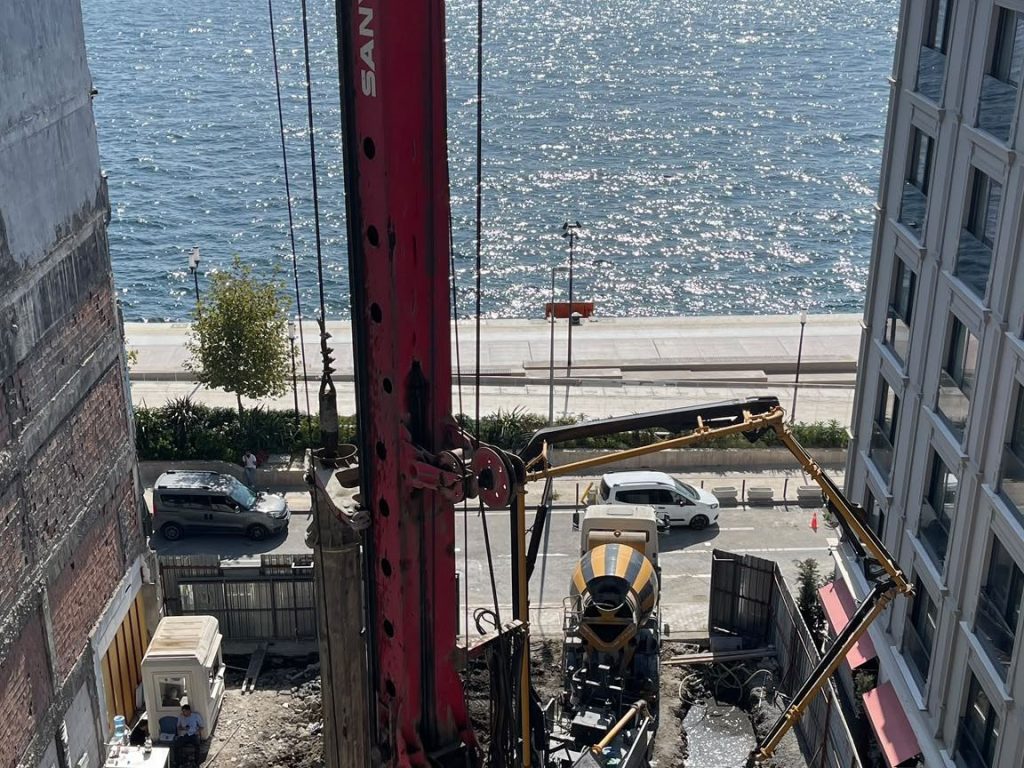
On our Karaköy job, for example, the narrow streets meant we could only work from 10:00 to 17:00. As a result, daily output fell and the programme felt it directly.
Worked example: 120 piles, 18 m long, Ø80 cm
Imagine a project with 120 bored piles, each 18 m long and Ø80 cm. First, we find the total drilling quantity: 120 × 18 = 2,160 m. Then the rate per metre multiplies this quantity, and the fixed items come on top.
Next, we work out the theoretical concrete volume. One metre of a Ø80 cm pile takes 0.503 m³ of concrete; therefore 2,160 m of pile means about 1,086 m³ in theory. On site the actual figure comes out slightly higher, because the borehole wall widens a little during drilling.
- Drilling and concreting: 2,160 m
- Rock drilling: a separate quantity, if any
- Temporary casing: a separate item, if needed
- Cage fabrication: per tonne or per metre
- Mobilisation: a one-off item
- Tests: per test
Estimate your own project
You can enter your own diameter, length and number of piles in the calculator below. The result is for an early budget only; the design sets the final quantities.
Optional: rough budget with your own unit rates
Rough budget: —
Theoretical geometric volume. Concrete use on site is usually slightly higher. Reinforcement, mobilisation and taxes are not included.
What does a quote include, and what does it leave out?
Most price differences come from differences in scope. So when you read a quote, first check who carries each item.
| Item | Usually carried by |
|---|---|
| Drilling and concreting | Piling contractor |
| Concrete and reinforcing steel | The client, on most jobs |
| Cage fabrication | The piling contractor, on most jobs |
| Temporary casing or bentonite | Piling contractor; a separate line in the quote |
| Mobilisation | Piling contractor; a separate line in the quote |
| Pile head trimming | The quote should state it clearly |
| PIT and load tests | Usually requested by the client; a separate item |
| Removing drill spoil from site | Usually part of the earthworks package |
In our own quotes we show drilling, rock drilling, cage fabrication and mobilisation on separate lines. That way, the client sees exactly what each item costs.
How should you compare two bored pile quotes?
A low unit rate does not always mean a cheap job. For instance, if one quote includes rock drilling and the other leaves it out, the comparison is wrong from the start.
- Diameter and length: Do both quotes price the same diameter and length?
- Rock drilling: Does it have its own rate, or is it missing?
- Borehole support: Does the quote include casing or bentonite?
- Measurement: Will payment measure length from the working platform or from cut-off level?
- Tests and mobilisation: Which quote includes which?
- Programme: How many rigs, and how many days?
Note: Skipping the tremie pipe or the tests is not a way to cut cost. That is why you should always ask about the construction method as well.
How can bored pile cost come down? Legitimate ways
There are ways to cut cost without giving up safety. However, most of them work at the design stage, before construction starts.
- Sound soil parameters: A good site investigation can stop piles from being longer than they need to be.
- Balancing diameter and length: The designer sometimes finds a cheaper layout with fewer, larger piles, or the reverse.
- Wall layout: Without groundwater, contiguous piles cost less than secant piles.
- Site preparation: A level working platform and good concrete logistics keep the rig from standing idle.
- Mixed solutions: For example, soil nails in the upper part of an excavation and an anchored wall below.
We review such proposals together with our design partner. You will find detailed examples in our guide on reducing shoring costs.
Which documents do we need for a quote?
The documents below are enough for an accurate quote. Still, write to us even if some are missing; we make an initial assessment and fill the gaps together.
- Site investigation report and borehole logs
- Pile layout plan with diameters, lengths and numbers
- Reinforcement details and concrete class (structural design)
- Shoring design and information on adjacent buildings, if any
- Site address, access width and target programme
Frequently asked questions about bored pile cost
We have collected the questions about price that we hear most often. However, if yours is not here, call us or write through the quote form.
Price and quotes
What is the rate per metre for bored piles in 2026?
We do not publish a fixed rate, because the price varies a great deal with the ground, diameter, length and quantity. Send us the borehole logs and the pile schedule, and we will quote from the quantities.
How much more does a Ø100 cm pile cost than a Ø80 cm pile?
One metre of a Ø100 cm pile takes 0.785 m³ of concrete, while a Ø80 cm pile takes 0.503 m³; in other words, concrete rises by about 56 percent. However, drilling time and steel also change, so the rate per metre may not rise by the same ratio.
Why does rock drilling have a separate rate?
Because drilling slows down sharply in hard rock and the tools wear faster. That is why we record the level where rock starts and show rock drilling as a separate quantity.
Who pays for concrete above the theoretical volume?
The contract should say so from the start. A small overrun is normal; however, if the overrun is clear, we investigate the cause on site together.
Why is mobilisation a separate line?
Moving the rig, crane and equipment to site and setting them up costs the same however many piles there are. For example, on small jobs this cost takes a larger share.

Request a quote for bored piles
Send us your site investigation and pile schedule. Then let us prepare a quantity-based quote and programme together.