

Knowledge Centre · Guide · Raft or piled foundation
Raft or Piled Foundation? Which One Do You Need, and When?
The answer to raft or piled foundation comes from the ground, not the building. In this guide we explain how each foundation works, when each one is enough and what options sit in between.
Topic
Choosing a foundation
Reading time
About 7 minutes
Written by
Abdullah Çetintaş, Geological Engineer
Updated
November 2026
Related services
Bored piles, jet grouting, site investigation
Who decides
Site investigation and structural design
Raft or piled foundation? First, the difference
A raft covers the whole footprint of the building with a single reinforced concrete slab and spreads the load over a wide area. If the ground can carry that load and settlement stays within limits, a raft is usually the most economical solution.
In a piled foundation, by contrast, piles take the load and carry it down to a firm layer. As a result, the weak upper layers drop out of the picture. However, piling adds cost and time.
| Topic | Raft | Piled foundation |
|---|---|---|
| How it carries load | Spreads it over a wide area | Takes it down to a firm layer |
| Suitable ground | Medium to firm ground | Soft clay, fill, high groundwater |
| Settlement | Depends on the ground; risk of differential settlement | Usually less |
| Cost and time | Usually lower | Piling adds to both |
| Liquefaction risk | Not enough on its own | Safer with ground improvement |
When is a raft enough?
If the site investigation shows enough bearing capacity and acceptable settlement, a raft is often enough. Also, in deep basements the excavation sometimes reaches a firm layer already, so the raft sits directly on it.
- A bearing layer such as stiff clay, dense sand or rock
- Sites where the groundwater stays below the foundation
- Moderate loads with an even distribution
- Ground with no liquefaction risk
When do you need a piled foundation?
You need piles when the upper layers cannot carry the load or when settlement would be too large. For example, this is common in coastal fills and in loose ground along stream beds.

- Soft clay, organic soil or thick fill
- Heavy loads such as tall buildings and industrial structures
- A risk that one part of the building settles more than another
- Tension piles needed against uplift from groundwater
- Sites at risk of liquefaction, together with ground improvement
We also cover this topic in short videos on our YouTube channel. However, the footage may be sample material for educational purposes.


You can find all our videos on our YouTube and Instagram accounts.
Two options in between: piled raft and ground improvement
Not every project has to sit at one of these two extremes. In a piled raft, for example, the raft carries part of the load while the piles reduce settlement; as a result, the number of piles can fall.
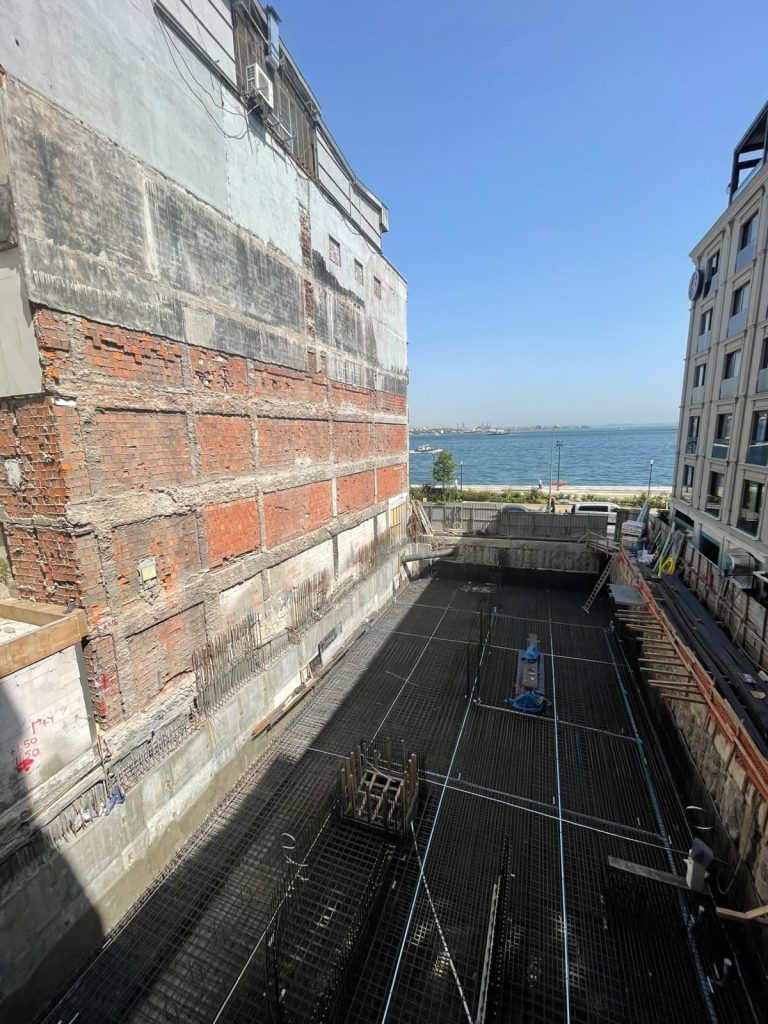
Another option is to improve the ground and place the raft on the improved soil. Jet grouting or deep soil mixing can do this. In Karaköy, for instance, we improved the ground under the foundation with jet grouting; when the excavation opened, the base about 4 m below sea level stayed dry.
Important: the site investigation and the structural design decide which option is right. As the contractor, we review the options with the designer; the final decision, however, belongs to the designer.
Raft or piled foundation? How to reach a decision
The decision starts with a sound site investigation. That is because bearing capacity, settlement and liquefaction calculations rely on borehole and laboratory data.
- Site investigation: the layers, the groundwater and the depth of firm ground.
- Loads: the number of storeys, basements and the load distribution.
- Earthquake: the ground class and liquefaction assessment under the Turkish Building Earthquake Code (TBDY 2018).
- Options: raft, piled raft, piled foundation or ground improvement.
- Cost and time: among options with the same safety, the more economical one.
If you do not have a site investigation yet, we can arrange one together with our drilling partner.
Raft or piled foundation: frequently asked questions
We have collected the questions about choosing a foundation that we hear most often. However, if yours is not here, call us or write through the quote form.
Choosing a foundation
How much more does a piled foundation cost than a raft?
There is no fixed ratio, because the number of piles, their length and the ground change on every project. Still, saving on piles where the ground is poor usually means paying more later to repair settlement.
Is a raft foundation safe in an earthquake?
Yes, if the ground is suitable and the design follows TBDY 2018. However, a raft alone is not enough on ground at risk of liquefaction; ground improvement or piles may be necessary.
Which comes up more in urban regeneration projects?
The ground on the plot decides. For example, plots on fill and soft clay tend to need piles or improvement, while plots on firm ground usually take a raft.
What is a piled raft?
In a piled raft, the raft and the piles share the load. In other words, the piles reduce settlement while the raft passes part of the load straight into the ground.
Does the number of basement storeys affect the decision?
Yes. A deep basement excavation may reach a firm layer, so the raft can sit directly on it. If there is groundwater, however, you also need to allow for uplift.

Let us review your foundation system together
Send us your site investigation and design. Then let us discuss the raft, piled raft and piled foundation options with your designer.