

Knowledge Centre · Guide · Bored piles or jet grouting
Bored Piles, Jet Grouting or Micropiles? How We Decide
Bored piles or jet grouting? We hear this question on site more than almost any other. The short answer is that the three methods solve different problems. In this guide we explain how they differ, when each one is right and how we reach a decision.
Topic
Choosing a method
Reading time
About 7 minutes
Written by
Abdullah Çetintaş, Geological Engineer
Updated
November 2026
Related services
Bored piles, jet grouting, micropiles
Region
Across Türkiye
Bored piles or jet grouting? The short answer
Bored piles and micropiles are separate elements that carry load. Jet grouting, by contrast, is not a pile but a ground improvement method; it makes the soil itself stronger and less permeable. So the real question is usually not “which one” but “which problem”.
| Topic | Bored piles | Jet grouting | Micropiles |
|---|---|---|---|
| What it does | Carries load down to a firm layer | Strengthens soil in place, cuts off water | Carries load down to a firm layer |
| Typical size | 60 cm diameter and above | Columns; size depends on the soil | Usually under 300 mm |
| Equipment | Heavy rig; needs open space | Drilling rig, pump, silo | Compact rig; fits in a basement |
| Existing building | Usually not suitable | Suitable; works beneath the building | Suitable; drills through the footing |
| Water cut-off | With a secant wall | With overlapping columns, under the base | No cut-off |
| Typical job | New foundations, retaining walls | Sealing, liquefaction, under footings | Underpinning, tight spaces |
When are bored piles the right choice?
Bored piles come first when a new structure has heavy loads and the upper layers cannot carry them. In addition, when a deep excavation needs a wall to hold up the neighbouring buildings, we usually build it with bored piles.
- Heavy loads, for example tall buildings, industrial plants or bridges
- Anchored or secant pile walls for deep basements
- Sites where firm ground or rock lies deep
- Open sites where a large rig can get in
For more detail, see our bored piles page.
When is jet grouting the right choice?
Jet grouting comes first when the problem is the soil itself rather than the load. For example, if an excavation goes below the water table, it needs a watertight base under the foundation.
- Cutting off water coming through the base and between piles
- Reducing settlement and liquefaction risk in loose sand and fill
- Strengthening weak ground under an existing footing
- Stabilising ground before shaft or tunnel excavation
On large open areas, however, deep soil mixing is often cheaper. We compare the two on our DSM page.
When are micropiles the right choice?
Micropiles step in where a bored piling rig cannot go. That is because compact rigs fit into basements, inside buildings and onto narrow plots.

- Underpinning an existing building that is settling
- Extra load from a new storey or a change of use
- Low-headroom basements and factory interiors
- Tension piles against uplift from groundwater
When do the three methods work together?
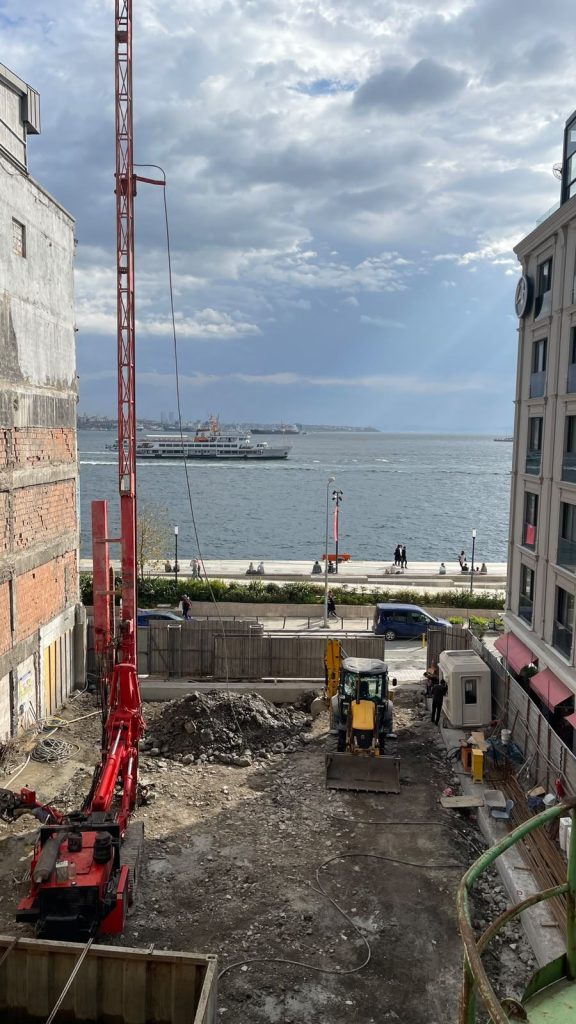
On many projects one method is not enough. In Karaköy, for example, we built secant bored piles for the shoring and jet grouting under the base; as a result, the foundation about 4 m below sea level stayed dry.
In existing buildings, we often consider micropiles and jet grouting together. While the micropiles carry the load down, the jet grouting strengthens the loose soil under the footing. Likewise, the large projects in our founder’s earlier career combined bored piles with deep soil mixing.
Bored piles or jet grouting? How we decide on site
We never decide on a single criterion. Instead, we work through the order below and then confirm the method with the designer.
- Site investigation: the layers, the depth of firm ground and the groundwater.
- Type of problem: do we need to carry load, cut off water or improve the soil?
- Access: can the rig get onto site, and how much headroom is there?
- Adjacent buildings: limits on vibration, pressure and movement.
- Time and cost: among options that give the same result, the more economical one.
A common misconception: treating jet grouting like a pile. A jet grout column has no reinforcement and is weak in tension; therefore, where bending or tension is needed, you need a pile.
Bored piles or jet grouting: frequently asked questions
We have collected the questions about choosing a method that we hear most often. However, if yours is not here, call us or write through the quote form.
Choosing a method
Can jet grouting replace piles?
Usually not. Jet grouting strengthens the soil and cuts off water; however, it has no reinforcement, so it cannot take tension and bending like a pile. That is why most projects use the two together.
Are micropiles cheaper than bored piles?
On open sites with heavy loads, bored piles are usually cheaper, because one bored pile carries the load of several micropiles. On the other hand, in a basement or a tight space micropiles may be the only option.
Can you install bored piles under an existing building?
In most cases no, because a bored piling rig cannot get inside the building. For existing buildings we usually use micropiles, jet grouting or grouting.
Which should we choose if there is groundwater?
With groundwater, a secant pile wall cuts off water around the excavation, while overlapping jet grout columns seal the base. In Karaköy, for example, we used both together.
Where does deep soil mixing fit in?
Like jet grouting, deep soil mixing is a ground improvement method. However, it is usually cheaper on large open areas and in soft ground.

Let us choose the right method for your project together
Send us your site investigation and design. Then let us work out together whether bored piles, jet grouting or micropiles suit your site.