


Services · Excavation support · Shotcrete
Shotcrete: Sprayed Concrete for Shoring, Slopes and Cut Faces
Shotcrete is concrete that travels through a hose and sprays onto the surface with compressed air. It needs no formwork, so it quickly covers cut faces, slopes and the gaps between piles.
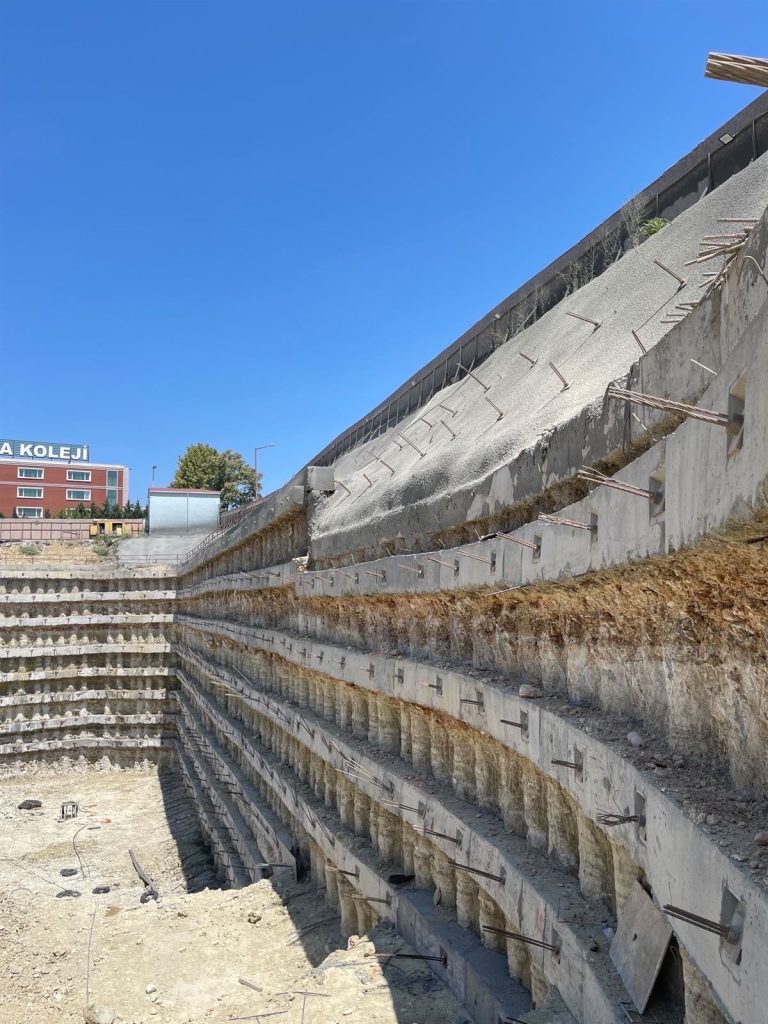
Method
Dry mix and wet mix
Reinforcement
Steel mesh or fibres
Use
Shoring, slopes, soil nailing
Drainage
Weep holes and drainage strips
Standard
EN 14487
Region
Türkiye and Central Asia
What is shotcrete?
Shotcrete is concrete sprayed under pressure onto a surface without formwork, where it sticks and hardens. It is also known as sprayed concrete; in Türkiye it is püskürtme beton. In excavation and slope work it covers the ground and stops it from falling away or drying out.
However, it is not a load-bearing system on its own. That is why we usually use it with soil nails, ground anchors or bored piles. In these systems, shotcrete is the facing that holds the soil between the elements.
Where is shotcrete used?
- Between the piles of spaced bored pile walls
- As the facing on soil nail walls and slopes
- To protect temporary cut slopes from rain and drying
- In underground work such as shafts, galleries and tunnels
- To repair old walls and reinforced concrete surfaces
Shotcrete methods: dry mix and wet mix
There are two methods. In the dry method the material enters the gun dry and water joins it at the nozzle. In the wet method, by contrast, a pump pushes ready-mixed concrete through the hose, and air and set accelerator join it at the nozzle.

| Topic | Dry mix | Wet mix |
|---|---|---|
| Adding water | At the nozzle, set by the operator | At the batching plant, fixed ratio |
| Rebound and dust | More | Less |
| Equipment | Small gun, compressor | Concrete pump |
| Best for | Small, scattered jobs and repairs | Large areas and fast output |
In short, the wet method gives a more consistent result over large areas. On small, scattered jobs and tight sites, however, the dry method is practical. Therefore, we choose the method with you based on the size of the job and the site.
Shotcrete for shoring and slope facing
In shoring we use shotcrete mostly with two systems. In either case, we also install drainage with the facing to release the water behind it.
Between spaced bored piles
Holds the soil between the piles and stops it falling out.
Soil nail walls
Forms the facing that ties the nail heads together.
Slope protection
Protects temporary slopes against rain, drying and ravelling.
Repairs
Repairs old concrete and wall surfaces without formwork.
How do we apply shotcrete?
We apply shotcrete in five steps. There is no formwork, so surface preparation and layer thickness directly decide the quality.
- Surface preparation: We clear loose soil and trim the surface.
- Drainage: We install drainage strips and weep holes.
- Reinforcement: We fix the steel mesh on spacers, clear of the surface.
- Spraying: We hold the nozzle square to the surface and build the concrete up layer by layer.
- Curing: We protect the surface from drying out and check the thickness.
The most common mistake we see on site: reusing rebound that has fallen to the ground. This material is low in cement and weakens the facing. That is why we always set rebound aside as waste.
We also explain shotcrete, and the ground where it does not work, in short videos. However, some of the footage may be sample material for educational purposes.

You can find all our videos on our YouTube and Instagram accounts.
Quality control of shotcrete
We track quality through thickness, strength and surface checks. For example, we check thickness with depth markers placed before spraying, or by drilling. For strength, a laboratory usually tests cores from panels sprayed under the same conditions.
| Check | What it shows | What it does not show |
|---|---|---|
| Thickness check | That the facing has the design thickness | Concrete strength |
| Panel cores | Strength of the sprayed concrete | The quality at every point of the wall |
| Visual check | Voids, sagging and cracks | Whether the space behind the mesh is fully filled |
The client usually asks for tests; when asked, our testing partner carries them out. Even on temporary shoring faces, like those in Küçükçekmece, we never skip thickness and drainage checks.
What does the price of shotcrete depend on?
We usually price shotcrete by square metre and thickness. However, surface regularity and access change the rebound and the cost. That is why we do not publish rates and quote from the quantities instead.
- Total area and thickness
- Mesh or fibre reinforcement
- Method: dry or wet mix
- Drainage strips and weep holes
- Surface regularity and access; the need for scaffolding
- Concrete supply, testing and mobilisation
What to send for a quote
- Shoring or slope design, with thickness and reinforcement details
- Total area and stage information
- Site address, access and programme
We usually quote shotcrete together with soil nails, anchors or bored piles. This way all the shoring items sit in a single programme.
Frequently asked questions about shotcrete
We have grouped the questions we receive by who asks them. If yours is not here, call us or write through the quote form.
Buying and cost
How much does shotcrete cost per square metre?
We do not publish a fixed rate, because the price depends on the thickness, the reinforcement and the site. Send us the design and we will quote from the quantities.
Who supplies the concrete?
We agree at quote stage who buys the concrete and state it clearly in the quote. It also pays to discuss rebound losses from the start.
Are shotcrete and sprayed concrete the same thing?
Yes. In other words, shotcrete and sprayed concrete are two names for the same work. In Türkiye it is called püskürtme beton, and specifications use these terms in the same sense.
Project managers and site engineers
How long does shotcreting take?
The area, thickness and excavation stages set the duration. We also cover the face stage by stage as the dig goes down. So we draw up the programme together with the excavation crew.
How long can a cut face stay open?
In general, the shorter the better. If the ground dries out or takes rain, it starts to ravel. That is why we try to cover each stage as soon as it opens.
Can you spray shotcrete in the rain?
Not in heavy rain, because the water washes the concrete off the surface. In light rain, however, it is possible to work with the surface protected.
What do you do in winter?
In freezing weather the concrete can freeze. So we adjust the mix and the curing to the air temperature, and postpone the work if needed.
How much rebound should we expect?
Generally, rebound varies with the method, the surface and the operator. It is higher with the dry method. So we allow for this loss in the quantities and the concrete order.
Supervising engineers and designers
How do you check thickness?
First, we fix thickness markers on the surface before spraying. If needed, we also drill the hardened facing and measure the thickness.
How do you measure strength?
A laboratory tests cores from panels sprayed under the same conditions in compression. The specification sets how often to test.
Mesh or fibres?
Both work. Mesh is more common, and it makes thickness easier to check. Fibres, on the other hand, help on irregular surfaces where fixing mesh is hard.
Which standard do you work to?
For materials and conformity we follow EN 14487 (sprayed concrete), which Türkiye adopts as TS EN 14487. On public works we also follow the client’s specification.
Owners and students
Is shotcrete permanent?
With the right thickness, reinforcement and drainage, it can also serve as a permanent facing. In shoring work, however, it is often temporary, and its job ends once the basement walls are built.
Why does shotcrete stick to the surface?
The concrete hits the surface at high speed, so it compacts and sticks. An accelerator also makes it set quickly. As a result, it works without formwork even on vertical and overhead surfaces.
Why do you need weep holes?
Simply put, weep holes drain the water that builds up behind the facing. Without them, the water presses on the facing and can crack it.

Sources
Request a quote for shotcrete
Send us your design and the area. We will settle the method, the thickness and a quantity-based quote together.