


Services · Marine structures · Quay construction
Quay Construction and Marine Structures: Piled Quays, Ground Improvement and Foundations
In quay construction the hardest part is the ground: soft seabed layers and water act directly on the foundations. That is why we build the foundations of quays and coastal structures with bored piles, jet grouting and ground improvement.

Foundation
Bored piles, secant where needed
Ground
Improvement with jet grouting
Drilling
Cased
Scope
Investigation, design, construction
Founder’s experience
AES Yachting, Kocaeli
Region
Türkiye and Central Asia
Quay construction and the ground: why is coastal ground hard?
On the coast, the ground often consists of soft marine deposits, fill and water. As a result, these layers cannot carry the load and they settle. Saturated sand can also liquefy during an earthquake.
That is why quay construction combines piles that carry the load down to a firm layer with improvement methods that strengthen weak ground. However, the site investigation decides which solution to use.
Risks in quay construction
- Excessive settlement on a soft seabed
- Liquefaction of saturated sand during an earthquake
- Bore collapse during drilling and concrete quality
- Corrosion in salt water
- Wave loads and berthing loads from ships
Types of quay and their foundations
There are three main types of quay. We focus on the foundation work for piled quays and on ground improvement under the fill.
| Type | How it works | Ground works |
|---|---|---|
| Piled quay | The deck sits on piles that go down through the seabed | Bored piles, rock sockets |
| Gravity quay | Blocks or caissons stand by their own weight | Base improvement, foundation bed |
| Sheet or pile wall quay | A pile or sheet pile wall holds the fill | Wall and anchors |
On a piled quay, for example, we drill the piles with casing and place the concrete by tremie. We also reduce settlement of the fill behind the quay with jet grouting.
How do we run quay construction?
We run a quay job step by step, from the site investigation to handover. Our partners carry out the investigation and design, while our own crews do the construction.
- Site investigation: Land and marine boreholes identify the layers and the firm ground.
- Design: With our design partner we design the pile layout and the ground improvement.
- Working platform: We build a platform for the piling rig on fill or on a jetty.
- Piling: We drill with casing and place the concrete by tremie.
- Ground improvement and deck: We improve the ground under the fill and tie the pile heads into the deck.
What we watch most closely on the coast: the effect of seawater on concrete and steel. So we check the concrete cover, concrete class and pouring method carefully against the design.
Our experience in quay construction
In an earlier role in 2021–2022, our founder, Abdullah Çetintaş, worked on the AES Yachting berthing jetty and shipyard project in the Kocaeli Free Zone. That role covered all the ground works, from the site investigation through bored piles and jet grouting to the quay and steel structure foundations. It also included managing the whole process from budget to handover.
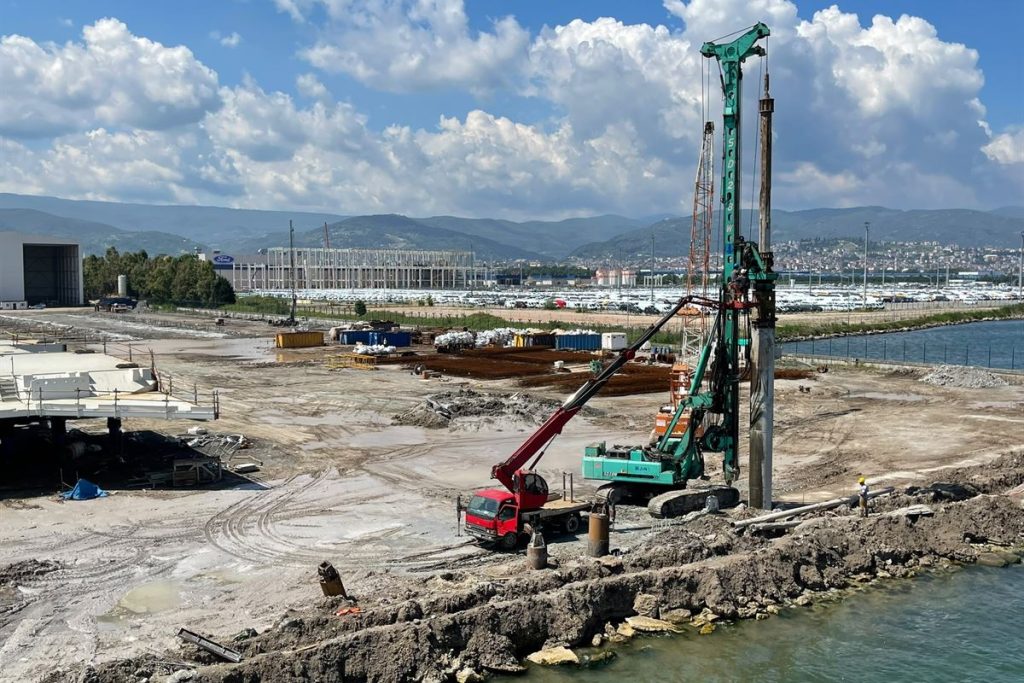
As Fen Zemin, we also built secant bored piles and jet grouting on the Karaköy waterfront for a foundation below sea level. See the Karaköy project.
What does the price of quay construction depend on?
In quay work, the ground and sea conditions set most of the cost. That is why we quote from the quantities after the investigation and design.
- Number, diameter and length of piles; rock sockets
- Casing and working over water
- Ground improvement quantities
- Working platform or jetty
- Concrete class, corrosion measures and testing
- Mobilisation and sea conditions
What to send for a quote
- Any land and marine boreholes
- Quay and deck design, or a concept design
- Water depth and site plan
- Target programme
Frequently asked questions about quay construction
We have grouped the questions we receive by who asks them. If yours is not here, call us or write through the quote form.
Clients and project managers
What work do you do in quay construction?
We build quay foundations with bored piles, jet grouting and ground improvement. We also run the investigation and design with our partners, and our own crews do the construction.
Do you drill the piles from the water?
Usually we first build a working platform with fill or a jetty. Then we run the rig from that platform. However, the water depth and the design decide which option suits.
How long does quay work take?
The number of piles, sea conditions and the platform set the duration. So after the investigation and design we give a programme based on the quantities.
Have you worked on the coast before?
Yes. As Fen Zemin, for example, we built secant piles and jet grouting on the Karaköy waterfront. Our founder also worked on the AES Yachting quay and shipyard project.
Site engineers
How does seawater affect drilling?
Water and loose seabed layers make the bore collapse. So we drill with casing and place the concrete from the base by tremie.
Do tides and waves hold up the work?
Waves and weather affect work over water. That is why we build weather allowance into the programme and plan critical pours for calm days.
What do you do against corrosion?
The design sets the concrete class, the cover and any extra protection. Following these values on site therefore has a direct effect on the life of the quay.
Designers
What sets the pile length?
Each pile must pass through the soft seabed and reach far enough into the firm layer. Horizontal ship loads and seismic effects also shape the pile design.
What can you do against liquefaction?
In fill and sandy layers, for example, jet grouting or another improvement method reduces the liquefaction risk. However, the design must follow TBDY 2018.
Academics and students
What is the difference between a piled quay and a gravity quay?
In a piled quay, the deck sits on piles that reach firm ground. In a gravity quay, by contrast, large blocks or caissons stay in balance by their own weight. That is why we more often choose a piled solution on a soft seabed.
Where do the horizontal loads on a quay come from?
Ship berthing, mooring line pull, waves and earthquakes all create horizontal loads. Consequently, piles, and sometimes raking piles, carry these loads.

Sources
Request a quote for quay construction
Send us any boreholes and your design. Let us plan the process from investigation to construction, and the quote, together.