


Geotechnical Testing & Pile Testing | Fen Zemin & İnşaat
Geotechnical Testing & Pile Testing | Fen Zemin & İnşaat
Fen Zemin & İnşaat provides geotechnical testing and monitoring services for deep foundations, bored piles and excavation support systems.
Our services include:
- Pile Load Testing
- Pile Integrity Testing (PIT)
- Inclinometer Monitoring
These methods are used for different engineering purposes.
A pile load test evaluates how a pile behaves under applied load.
Pile Integrity Testing assesses pile continuity and helps identify indications of significant changes in pile section or material.
Inclinometer monitoring is used to measure lateral movement within the ground or retaining system with depth.
For this reason, the appropriate test or monitoring method should be selected according to the engineering question that needs to be answered.
Why Is Geotechnical Testing Important?
Much of a geotechnical structure remains below ground after construction.
Bored piles, deep foundation elements, retaining systems and the ground surrounding an excavation cannot always be assessed by visual inspection alone.
Geotechnical testing and monitoring provide field data that can be compared with:
- design assumptions,
- construction records,
- acceptance criteria,
- observed site behaviour.
The objective is not simply to perform a test.
The test method should provide information relevant to the performance of the foundation or retaining system.
Pile Load Testing
Pile load testing is used to evaluate the response of a pile under controlled loading.
During the test, load is applied to the pile according to a defined procedure and the corresponding pile movement is measured.
For static axial compression testing, the relationship between applied load and pile displacement provides information about the behaviour of the deep foundation element.
ASTM standards for static axial compressive testing address the measurement of pile deflection under controlled loading and require the results to be interpreted in the context of the foundation design.
The loading programme, maximum test load and acceptance criteria should therefore be defined by the project engineer or technical specification.
Why Is a Pile Load Test Performed?
A pile load test may be used to:
- assess pile load-displacement behaviour,
- compare field performance with design assumptions,
- verify project acceptance criteria,
- support evaluation of foundation performance,
- provide data for pile design or construction decisions.
The test should not be treated as an isolated site activity.
Pile dimensions, construction records, concrete information, ground conditions and design loads may all be relevant when interpreting the results.
How Is a Pile Load Test Carried Out?
The exact test arrangement depends on the project and test method.
A typical static axial compression test may include:
1. Test Pile Preparation
The pile head is prepared so that the load can be applied safely and measurements can be taken accurately.
2. Reaction System
A reaction system is established to resist the applied test load.
Depending on the project, this may involve reaction piles, anchors, beams or another approved system.
3. Loading
The pile is loaded in controlled increments according to the specified test procedure.
4. Settlement Measurement
Pile movement is measured independently from the loading system.
Measurements are recorded at the required load and time intervals.
5. Unloading
The pile is unloaded according to the test procedure and recovery movements may also be recorded.
6. Evaluation
The resulting load-displacement data are interpreted according to the project requirements and the applicable engineering criteria.
What Does a Pile Load Test Show?
A pile load test provides direct information about the response of the tested pile under the applied loading programme.
The results may show:
- pile settlement under increasing load,
- load-displacement behaviour,
- movement during load holding,
- residual displacement after unloading.
The interpretation should be carried out together with the design assumptions and test specification.
One test result should not automatically be applied to every pile on a site without considering differences in ground conditions, pile geometry or construction.
Pile Integrity Testing (PIT)
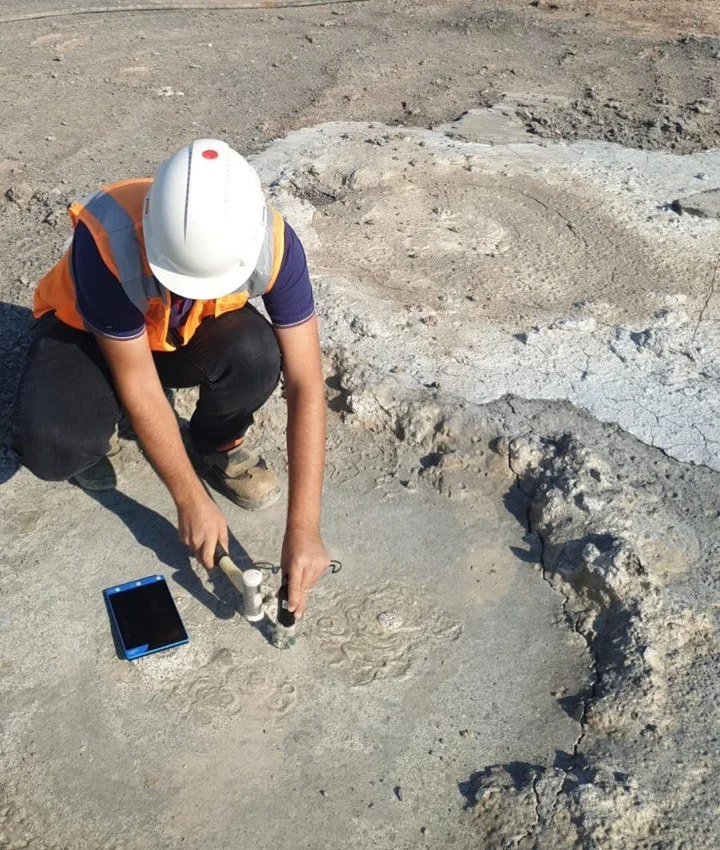
Pile Integrity Testing, commonly referred to as PIT, is a low-strain test used to assess the integrity and continuity of deep foundation elements such as bored piles.
A small impact is applied to the pile head and the resulting wave response is measured.
The recorded signal is then analysed to identify reflections that may indicate changes in the pile.
PIT is particularly useful because most of a completed bored pile cannot be directly inspected after concreting.
What Can Pile Integrity Testing Detect?
Depending on the quality of the test signal and pile/site conditions, PIT may provide indications of:
- changes in pile cross-section,
- significant changes in material consistency,
- discontinuities,
- pile length response,
- possible anomalies requiring further evaluation.
The method is approximate and should be interpreted together with construction records, ground conditions and information from comparable piles.
What PIT Does Not Measure
Pile Integrity Testing does not directly determine pile bearing capacity.
This distinction is important.
A pile may show an acceptable integrity response while its load-bearing behaviour still needs to be assessed by design or load testing.
Similarly, an unusual PIT signal does not automatically prove that a pile has failed structurally.
The result should be evaluated by qualified personnel together with the available construction and site information.
How Is Pile Integrity Testing Performed?
A typical PIT procedure includes:
1. Pile Head Preparation
The pile head should provide suitable concrete contact for the sensor and impact.
Loose, weak or contaminated surface material may need to be removed.
2. Sensor Installation
A motion sensor is attached to the prepared pile head.
3. Impact
A small handheld hammer or similar impact device is used to generate a low-strain stress wave.
4. Signal Recording
The pile response is recorded by the test equipment.
5. Interpretation
Reflections in the signal are analysed to evaluate pile continuity and identify possible changes along the pile shaft.
Multiple measurements may be taken to improve the reliability of the assessment.
Pile Load Testing vs Pile Integrity Testing
Pile load testing and Pile Integrity Testing answer different engineering questions.
Pile Load Testing
Evaluates how the pile behaves under applied structural load.
It focuses on load and movement.
Pile Integrity Testing
Evaluates pile continuity and identifies indications of possible changes in pile geometry or material.
It focuses on the physical integrity of the pile.
PIT should therefore not be used as a replacement for a load test where pile capacity or load-displacement performance needs to be verified.
Inclinometer Monitoring
An inclinometer is used to measure lateral displacement within the ground or a retaining system with depth.
In deep excavation projects, inclinometer monitoring can help track how the ground or retaining structure moves as excavation progresses.
A casing is installed vertically or near vertically within the ground or structural system.
Measurements are then taken at defined depth intervals.
By comparing repeated readings over time, the location and magnitude of lateral movement can be identified.
Where Is Inclinometer Monitoring Used?
Inclinometers may be used in:
- deep excavations,
- retaining walls,
- bored pile retaining systems,
- slopes,
- embankments,
- ground movement monitoring,
- infrastructure projects.
In deep excavations, monitoring may be particularly important where neighbouring structures, roads or utilities are sensitive to movement.
FHWA guidance describes inclinometer systems as tools for monitoring subsurface deformation and lateral movements around excavations.
How Does Inclinometer Monitoring Work?
The system generally consists of an inclinometer casing installed in the ground or retaining system.
The casing contains internal guide grooves.
Measurements are taken at specified depth intervals using an inclinometer probe or monitoring system.
The measured inclination at each depth is converted into lateral displacement.
Repeated readings are compared with an initial baseline measurement.
This allows changes in movement to be tracked throughout excavation or construction.
Why Is a Baseline Reading Important?
An inclinometer system should have an initial reference condition.
This baseline allows subsequent readings to be compared with the original position of the casing.
Without a reliable baseline, it becomes difficult to determine how much movement occurred during later construction stages.
For this reason, the timing of installation and initial readings should be coordinated with the excavation sequence.
Inclinometer Monitoring in Deep Excavations
Deep excavation behaviour can change as excavation proceeds.
Removing soil reduces lateral support and changes the stress state around the retaining system.
If anchors, struts or other support systems are installed in stages, each construction stage may affect movement.
Repeated inclinometer readings can therefore be used to monitor how the system responds over time.
Monitoring results may be reviewed together with:
- excavation level,
- anchor installation,
- anchor stressing,
- internal bracing,
- groundwater conditions,
- nearby construction activities.
How Are Geotechnical Test Results Evaluated?
A test result should not be interpreted without context.
Fen Zemin & İnşaat considers the available project information together with field measurements.
Depending on the test, this may include:
- ground investigation data,
- pile construction records,
- concrete records,
- pile geometry,
- design loads,
- excavation stages,
- retaining-system details,
- previous monitoring readings.
The objective is to understand what the measured result means for the actual project.
When Should Geotechnical Testing Be Planned?
Testing and monitoring are most effective when considered before construction begins.
If pile testing is required, test piles, production piles, reaction systems and test access may need to be incorporated into the programme.
For inclinometer monitoring, casing installation and baseline readings should be coordinated with the excavation sequence.
Planning these activities after construction has already progressed may limit the available options.
Quality Control for Bored Pile Projects
Bored pile quality control can include several complementary methods.
Construction records may provide information on:
- drilling depth,
- encountered ground,
- reinforcement,
- concrete volume,
- construction time.
Pile Integrity Testing may provide information related to pile continuity.
Pile load testing may provide information about load-displacement performance.
These methods should not be considered interchangeable.
Together, they can provide a more complete picture of pile construction and performance.
Geotechnical Testing Cost
The cost of geotechnical testing depends on the selected method and project requirements.
For pile load testing, cost may be affected by:
- required test load,
- reaction system,
- pile size,
- test procedure,
- site access,
- test duration,
- mobilisation.
For PIT, cost may depend on:
- number of piles,
- pile-head preparation,
- access,
- mobilisation.
For inclinometer monitoring, cost may depend on:
- casing depth,
- number of monitoring locations,
- installation conditions,
- number of reading campaigns,
- monitoring period.
For this reason, a quotation should be based on the actual testing or monitoring scope.
How Does Fen Zemin & İnşaat Evaluate a Testing Project?
The first step is to define what information the project needs.
Where available, we review:
- geotechnical design,
- pile schedule,
- pile dimensions,
- design loads,
- technical specifications,
- retaining-wall sections,
- monitoring requirements,
- project location.
The required test or monitoring method is then evaluated together with site access and construction sequence.
The aim is to perform the appropriate field measurement for the engineering question rather than applying the same test programme to every project.
Geotechnical Testing in Istanbul and Across Türkiye
Fen Zemin & İnşaat is based in Ümraniye, Istanbul.
Pile testing and geotechnical monitoring projects in Istanbul and other regions of Türkiye may be evaluated according to project scope, number of tests, mobilisation requirements and site conditions.
Each testing programme is reviewed individually before field operations are planned.
Geotechnical Testing Frequently Asked Questions
What geotechnical tests does Fen Zemin & İnşaat provide?
Fen Zemin & İnşaat provides pile load testing, Pile Integrity Testing and inclinometer monitoring within its geotechnical testing and monitoring services.
What is a pile load test?
A pile load test applies controlled load to a pile and measures the resulting movement to evaluate its load-displacement behaviour.
What is Pile Integrity Testing?
Pile Integrity Testing is a low-strain method used to assess pile continuity and identify indications of significant changes in pile section or material.
Does PIT measure pile bearing capacity?
No. PIT does not directly determine pile bearing capacity. Load-bearing performance requires appropriate design evaluation and, where specified, pile load testing.
What is an inclinometer used for?
An inclinometer is used to measure lateral movement with depth in soil, slopes or retaining systems.
Why are inclinometers used in deep excavations?
They help track lateral movement of the ground or retaining system as excavation progresses.
Is pile load testing the same as PIT?
No. Pile load testing evaluates pile behaviour under applied load. PIT evaluates pile integrity and continuity.
When should pile testing be planned?
Preferably during project and construction planning, so that test piles, reaction systems, access and programme requirements can be coordinated.
What information is required for a geotechnical testing quotation?
Where available, the geotechnical design, pile schedule, test loads, pile dimensions, number of tests, monitoring requirements, project location and site information should be provided.
Discuss Your Geotechnical Testing Requirements with Fen Zemin & İnşaat
For pile load testing, Pile Integrity Testing or inclinometer monitoring, you can share the available project information with Fen Zemin & İnşaat.
Where available, provide the geotechnical design, pile schedule, required test loads, monitoring scope and site information so that the appropriate testing programme can be reviewed accurately.
Contact the Fen Zemin & İnşaat technical team to discuss your geotechnical testing and monitoring requirements.