


Bored Piling & Deep Foundations | Fen Zemin & İnşaat
Bored Piling & Deep Foundations | Fen Zemin & İnşaat
Fen Zemin & İnşaat carries out bored piling for deep foundation and excavation support projects, with pile geometry, drilling method and construction sequence determined according to the geotechnical design, structural requirements and actual site conditions.
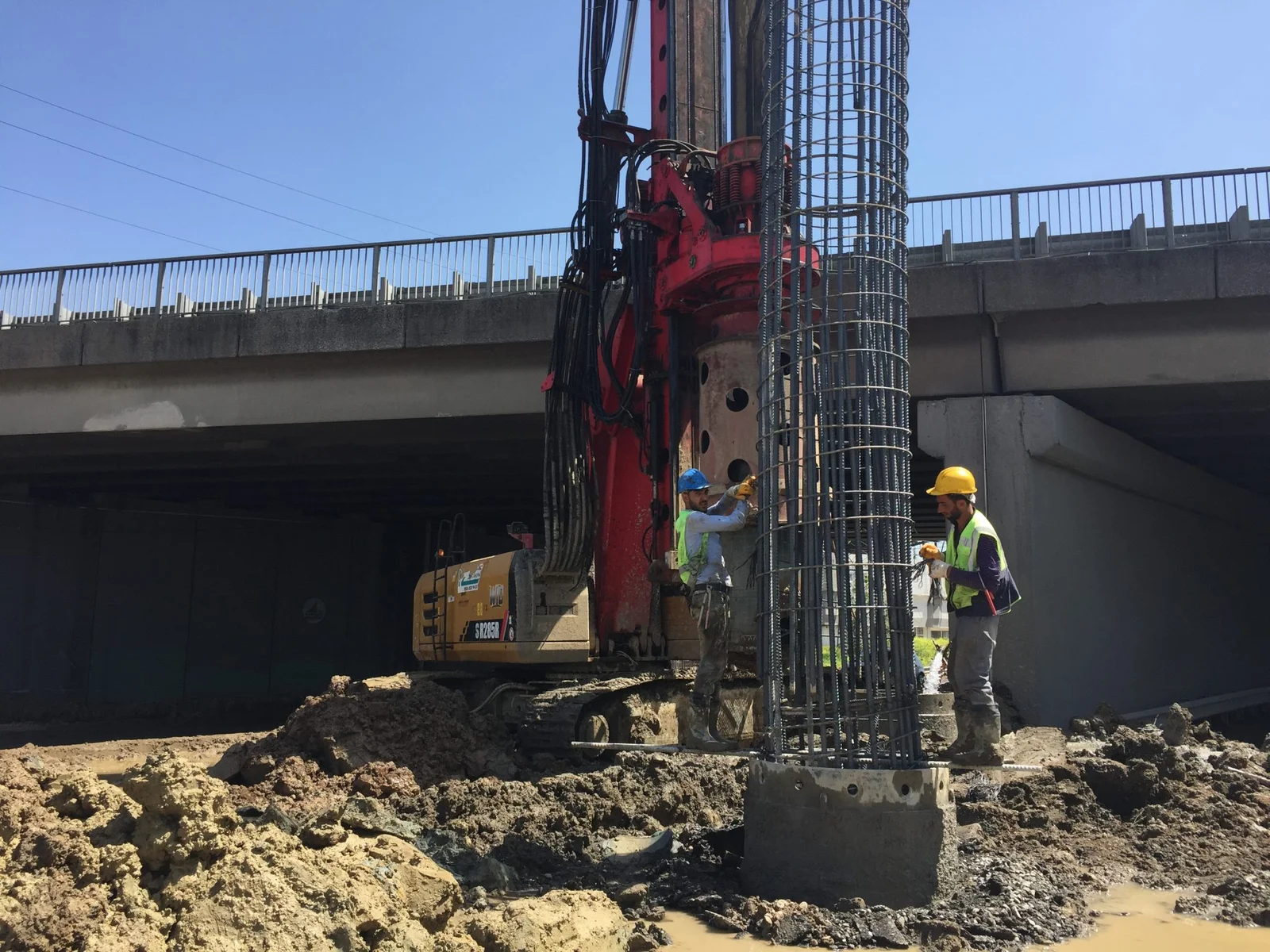
Bored piles are cast-in-place reinforced concrete elements formed by drilling a circular borehole, installing the reinforcement cage and placing concrete.
They may be used as structural deep foundation elements or as vertical members in retaining and excavation support systems.
At Fen Zemin & İnşaat, bored piling is evaluated as a complete field process involving drilling, bore stability, reinforcement, concreting, site logistics and quality control.
What Is a Bored Pile?
A bored pile is a cast-in-place deep foundation element constructed by forming a borehole in the ground and filling it with reinforced concrete.
Depending on the project, bored piles may be designed to transfer structural loads to deeper soil or rock layers or to form part of a retaining system.
The pile does not function simply because a hole has been drilled and filled with concrete.
Its performance depends on the relationship between:
- pile geometry,
- ground conditions,
- structural loading,
- reinforcement,
- concrete placement,
- construction quality.
For this reason, bored pile design and bored pile construction should be evaluated together.
Where Are Bored Piles Used?
Bored piles are commonly used in projects where shallow foundations are not suitable or where deep excavation support is required.
Typical applications include:
- residential developments,
- commercial buildings,
- industrial facilities,
- high-rise structures,
- deep basements,
- retaining systems,
- infrastructure projects,
- bridge and transportation structures,
- sites with weak or compressible near-surface soils.
They may also be used where foundation loads are high or where settlement control requires load transfer to deeper bearing layers.
Bored Piles as Deep Foundations
In deep foundation applications, bored piles transfer structural loads through the pile shaft, pile base or a combination of both mechanisms.
The required pile diameter and length depend on the structural loads and geotechnical conditions.
The design may consider:
- axial compression,
- uplift,
- lateral loading,
- settlement,
- group effects,
- pile-soil interaction.
Pile dimensions should therefore not be selected only from previous project experience.
They need to respond to the specific loading and ground profile of the project.
Bored Piles in Excavation Support
Bored piles can also be used as vertical retaining elements in deep excavations.
Depending on the spacing and design, bored pile walls may form part of:
- contiguous pile walls,
- secant-type retaining systems,
- anchored retaining systems,
- internally braced excavation support systems.
Where excavation depth and lateral ground pressures require additional support, bored piles may be combined with prestressed ground anchors or internal bracing.
In these projects, construction sequence and deformation control are particularly important.
How Is a Bored Pile Constructed?
Bored pile construction consists of several connected stages.
1. Project and Site Review
Before drilling begins, the pile layout and available geotechnical information are reviewed.
Important project information may include:
- pile diameter,
- pile length,
- reinforcement details,
- pile coordinates,
- cut-off levels,
- ground investigation data,
- groundwater conditions.
Site access and equipment requirements are also considered.
A design may be technically correct but difficult to execute if the piling rig cannot safely access or operate within the site.
2. Setting Out
Pile positions are established according to the approved project coordinates.
Accurate setting out is important because pile location can affect the foundation system, pile cap geometry and retaining-wall alignment.
Survey control should be maintained throughout the works.
3. Drilling
The borehole is drilled to the required depth using a rotary piling rig and suitable drilling tools.
The drilling tool may vary depending on the encountered ground.
Possible equipment may include:
- augers,
- drilling buckets,
- core barrels,
- rock drilling tools,
- temporary casing.
The actual drilling method should respond to the soil and rock conditions encountered in the field.
4. Bore Stability
Bore stability is a critical part of bored pile construction.
Loose soils, granular layers or groundwater may cause collapse or instability within the borehole.
Depending on site conditions, temporary casing or another approved bore-support method may be required.
The method should be selected according to the ground profile, groundwater and pile geometry.
5. Borehole Inspection
Before reinforcement and concreting, the borehole depth and construction condition are checked.
Where required, base cleanliness and other construction criteria may also be reviewed.
The objective is to confirm that the borehole is suitable for the next stage of pile construction.
6. Reinforcement Cage Installation
The reinforcement cage is fabricated according to the structural design and lowered into the borehole.
Reinforcement details may include:
- longitudinal reinforcement,
- links or spiral reinforcement,
- spacers,
- lifting arrangements,
- cage connections.
Long cages may need to be installed in sections and connected during lowering.
The lifting and installation sequence should prevent excessive deformation or damage to the reinforcement cage.
7. Concrete Placement
Concrete is placed into the borehole using the method required by the site conditions and technical specification.
Where groundwater or bore-support fluids are present, a tremie-type placement procedure may be required.
Continuous and controlled concrete placement is important for the integrity of the pile.
The construction sequence should minimise the risk of segregation, contamination or discontinuity.
How Are Pile Diameter and Depth Selected?
There is no single bored pile diameter or depth suitable for every project.
Pile dimensions are determined from:
- structural loads,
- ground profile,
- required capacity,
- settlement criteria,
- pile group behaviour,
- construction conditions.
A larger pile is not automatically a better pile.
Increasing pile diameter or length can affect cost, reinforcement, drilling time and equipment requirements.
The appropriate pile geometry should therefore be determined through geotechnical and structural design.
How Do Ground Conditions Affect Bored Piling?
Ground conditions directly influence the drilling method and production rate.
Clay and Cohesive Soils
Cohesive soils may provide relatively stable bore conditions, but consistency and groundwater still need to be considered.
Sand and Gravel
Granular soils may require additional bore-support measures, particularly where groundwater is present.
Fill
Fill deposits may be heterogeneous and may contain unexpected materials or obstructions.
Weathered and Competent Rock
Rock layers may require different drilling tools and significantly different production rates.
For this reason, the borehole log and actual field conditions should be compared with the ground investigation data during construction.
How Does Groundwater Affect Bored Piles?
Groundwater can influence bore stability, drilling conditions and concrete placement.
In loose granular soils, uncontrolled groundwater may increase the risk of bore collapse or material inflow.
The construction method therefore needs to consider both the groundwater level and the permeability of the surrounding soil.
Groundwater should not be treated as a secondary issue after drilling begins.
It is part of the bored pile construction methodology.
What Is the Difference Between Foundation Bored Piles and Retaining Bored Piles?
The same construction technique can serve different structural purposes.
Foundation Bored Piles
Foundation piles transfer building or structural loads into deeper ground.
Their primary design concern is foundation performance.
Retaining Bored Piles
Retaining piles resist lateral ground pressures and support excavation.
They may also need to control deformation and work together with anchors, walers or internal bracing.
The drilling process may be similar, but the structural behaviour and design objectives are different.
Bored Pile Quality Control
Quality control is important because most of the completed pile remains below ground and cannot be visually inspected.
Depending on project requirements, quality control may include:
- drilling records,
- depth records,
- reinforcement records,
- concrete records,
- concrete volume monitoring,
- pile load testing,
- Pile Integrity Testing,
- site inspection.
Construction records should be maintained consistently throughout the project.
Pile Load Testing
Pile load testing is used to evaluate the load-displacement response of a pile under controlled loading.
The test procedure depends on the project specification and the type of loading being assessed.
A pile load test can provide direct information about pile behaviour under load.
It should not be confused with an integrity test.
Pile Integrity Testing
Pile Integrity Testing, commonly referred to as PIT, is a low-strain test used to assess pile continuity and identify indications of significant changes in pile section or material.
PIT does not directly measure pile bearing capacity.
The two tests therefore answer different engineering questions.
Bored Pile Equipment Selection
The piling rig should be selected according to the actual project conditions.
Important factors include:
- required pile diameter,
- drilling depth,
- ground and rock conditions,
- access width,
- working platform,
- headroom,
- surrounding structures,
- casing requirements.
The largest available drilling rig is not automatically the correct machine for every project.
In restricted urban sites, mobilisation and safe machine movement may be just as important as theoretical drilling capacity.
Fen Zemin & İnşaat evaluates equipment selection as part of the construction plan.
Working Platform and Site Conditions
Heavy rotary piling rigs require a suitable working platform.
The platform needs to support the equipment during drilling, movement and lifting operations.
Site preparation should therefore consider:
- bearing conditions,
- platform level,
- access roads,
- crane operations,
- reinforcement cage handling,
- spoil removal,
- concrete truck access.
Poor site organisation can affect both safety and production.
Bored Pile vs Micropile
Bored piles and micropiles are both deep foundation systems, but they are used under different project conditions.
Bored piles are generally larger-diameter cast-in-place reinforced concrete elements installed with heavy rotary drilling rigs.
Micropiles are smaller-diameter drilled and grouted elements that can be useful in restricted-access, low-headroom and foundation strengthening projects.
The appropriate system depends on the structural loads, available space, ground conditions and project requirements.
Bored Pile vs Jet Grouting
A bored pile and a jet grout column serve different engineering purposes.
A bored pile is generally a structural deep foundation or retaining element.
Jet grouting is a ground improvement method that modifies the existing soil by creating soil-cement elements.
They should not be considered direct alternatives simply because both methods involve drilling.
The engineering objective must be identified first.
Bored Pile Cost
Bored pile cost should not be evaluated solely as a price per metre.
The total cost may be affected by:
- pile diameter,
- pile length,
- total quantity,
- reinforcement,
- concrete volume,
- ground conditions,
- rock drilling,
- casing requirements,
- groundwater,
- site access,
- working platform,
- mobilisation.
Two projects with the same total pile length can have very different costs if the pile diameters, ground conditions or reinforcement requirements are different.
For this reason, Fen Zemin & İnşaat reviews the available project information before preparing a quotation.
How Does Fen Zemin & İnşaat Evaluate a Bored Pile Project?
The first step is to review the technical information available for the project.
Where available, we examine:
- ground investigation report,
- geotechnical design,
- structural drawings,
- pile schedule,
- pile diameters,
- pile lengths,
- reinforcement details,
- project location.
The site conditions are then evaluated.
Access, working-platform dimensions, nearby buildings, groundwater, reinforcement cage handling and concrete supply can all affect the construction process.
The objective is to determine a method that satisfies the design requirements and can be executed safely and efficiently under the actual site conditions.
Bored Piling in Istanbul and Across Türkiye
Fen Zemin & İnşaat is based in Ümraniye, Istanbul.
Bored piling projects in Istanbul and other regions of Türkiye can be evaluated depending on project size, pile quantities, mobilisation requirements, ground conditions and site access.
Our bored piling work may include deep foundations, retaining systems, residential developments, commercial buildings, industrial facilities and infrastructure projects.
Each project is assessed individually before the equipment and construction methodology are defined.
Bored Piling Frequently Asked Questions
What is a bored pile?
A bored pile is a cast-in-place reinforced concrete deep foundation element constructed by drilling a borehole, installing reinforcement and placing concrete.
What are bored piles used for?
Bored piles may be used for deep foundations, retaining walls and excavation support systems.
How deep can bored piles be installed?
There is no single fixed depth. Pile depth depends on structural loads, ground conditions, design requirements and the available drilling equipment.
What determines bored pile diameter?
Pile diameter is determined by the structural and geotechnical design, required load capacity, ground conditions and construction requirements.
Can bored piles be used in groundwater?
Yes, but groundwater and bore stability must be considered in the construction method. Additional bore-support measures or specific concrete-placement procedures may be required.
What is the difference between bored piles and micropiles?
Bored piles are generally larger-diameter cast-in-place reinforced concrete elements, while micropiles are smaller-diameter drilled and grouted foundation elements often used in restricted-access or strengthening projects.
What is the difference between bored piles and jet grouting?
Bored piles are structural deep foundation or retaining elements. Jet grouting is a ground improvement technique that creates soil-cement elements in situ.
Are bored piles tested after construction?
Depending on project requirements, pile load tests, Pile Integrity Testing or other quality-control procedures may be specified.
What determines bored pile cost?
Pile diameter, length, reinforcement, ground conditions, rock drilling, casing, groundwater, site access and mobilisation can all affect the total cost.
What information is required for a bored pile quotation?
Where available, the ground investigation report, pile design, pile schedule, diameters, lengths, reinforcement details, project location and site information should be provided.
Discuss Your Bored Piling Project with Fen Zemin & İnşaat
For deep foundation, retaining-wall or excavation support projects involving bored piles, you can share your available technical information with Fen Zemin & İnşaat.
Where available, provide the ground investigation report, pile design, pile schedule, quantities and site information so that the technical scope and construction requirements can be reviewed accurately.
Contact the Fen Zemin & İnşaat technical team to discuss your bored piling project.