


Dynamic Compaction for Ground Improvement | Fen Zemin & İnşaat
Dynamic Compaction for Ground Improvement | Fen Zemin & İnşaat
Fen Zemin & İnşaat carries out dynamic compaction for the improvement of suitable granular soils and fill deposits.
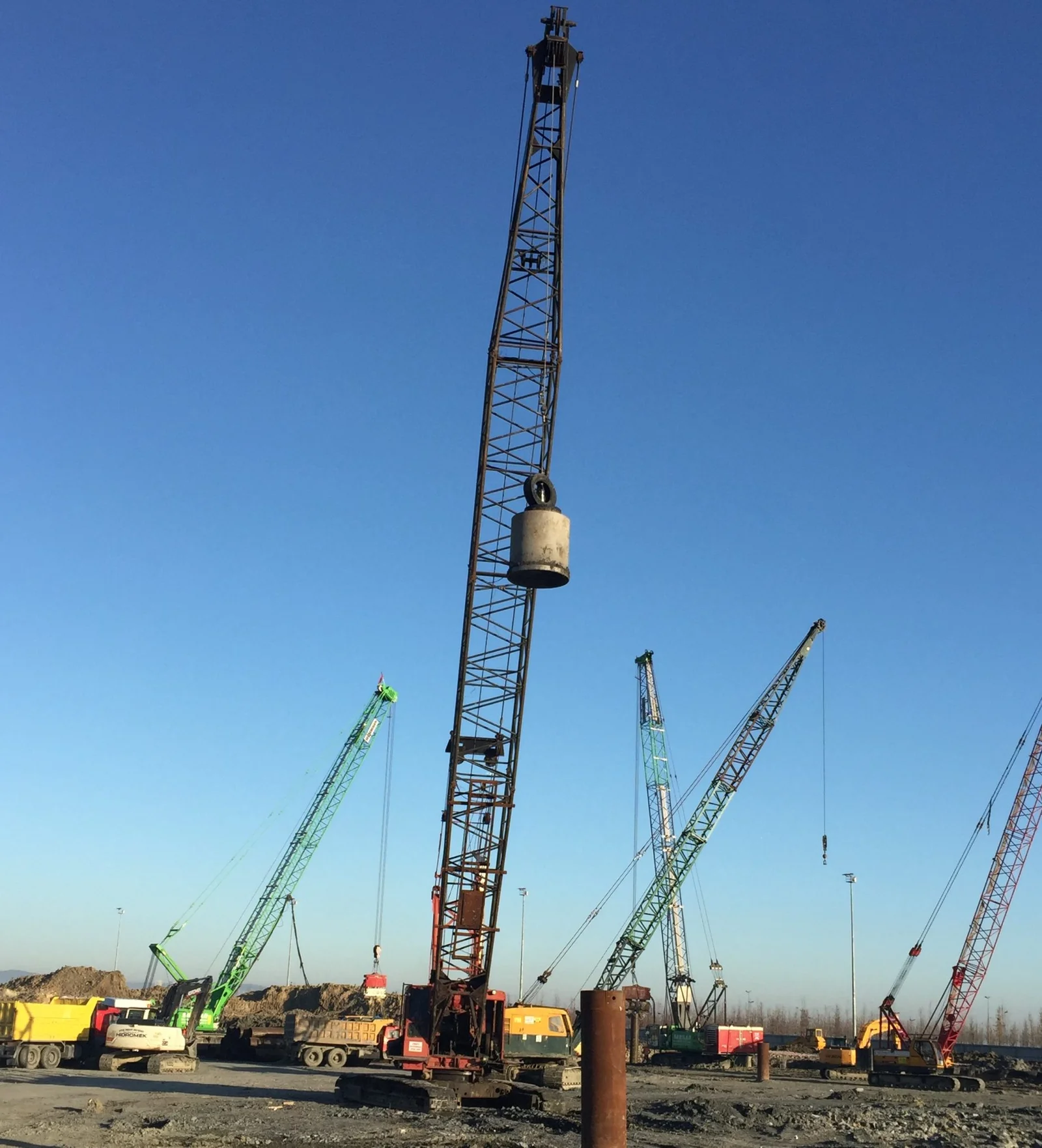
Dynamic compaction is a ground improvement method in which a heavy tamper is repeatedly dropped from a predetermined height onto the ground surface. The resulting impact energy is transmitted into the underlying soil and, under suitable conditions, increases density, reduces voids and improves the engineering behaviour of the ground.
The method is not suitable for every soil or every site.
Fen Zemin & İnşaat evaluates ground investigation data, fill characteristics, groundwater conditions, required treatment depth, structural loads, available working area and nearby structures before determining whether dynamic compaction is appropriate.
What Is Dynamic Compaction?
Dynamic compaction is an in-situ ground improvement technique based on the controlled application of high-energy impacts.
A heavy tamper is lifted by a crane or suitable lifting equipment and repeatedly dropped onto predetermined points across the treatment area.
The impact energy causes suitable soils to densify and rearrange into a more compact structure.
Several impacts may be applied at the same location before the operation moves to the next point.
The field is generally treated using a planned grid or impact pattern.
Tamper weight, drop height, number of blows, grid spacing and number of passes are not fixed values. They are selected according to the ground conditions and the required performance of the improved soil.
Why Is Dynamic Compaction Used?
The principal objective of dynamic compaction is to improve the engineering behaviour of loose ground or fill by increasing density.
Depending on the project, dynamic compaction may be considered for:
- densification of loose soils,
- improvement of uncontrolled or heterogeneous fills,
- reduction of future settlements,
- improvement of ground support conditions,
- reduction of large voids within suitable fills,
- reduction of liquefaction potential in suitable loose granular soils.
The required performance target should be defined before construction begins.
The objective should not simply be described as “compacting the ground.”
The project should identify what improvement is required in terms of settlement, density, bearing behaviour or other geotechnical criteria.
Which Soils Are Suitable for Dynamic Compaction?
The effectiveness of dynamic compaction depends strongly on the ground profile.
The method is commonly considered for loose granular soils and suitable natural or man-made fills.
Granular Soils
Loose sands, gravels and similar granular deposits may respond well to high-energy impact treatment.
The impact energy can cause particles to rearrange into a denser configuration.
As the percentage of fines increases, the ground response may change significantly.
For this reason, suitability should not be determined solely from a basic soil classification.
Fill Deposits
Existing fill areas can present significant variability.
Uncontrolled fills may contain materials placed at different times, different densities and with different particle sizes.
Dynamic compaction may be considered after the depth, composition and engineering characteristics of the fill have been investigated.
Saturated Soils
The presence of groundwater does not automatically mean that dynamic compaction can or cannot be used.
In suitable granular soils, treatment may still be possible.
However, high-energy impacts can generate excess pore water pressures, and the time required for these pressures to dissipate may influence the construction sequence.
Groundwater conditions should therefore be considered as part of the design.
Cohesive Soils
Low-permeability, fine-grained and soft cohesive soils may not respond to dynamic compaction in the same way as granular deposits.
Where drainage is limited, alternative ground improvement methods may be more appropriate.
Fen Zemin & İnşaat does not select dynamic compaction solely from surface appearance or general soil description.
How Is Dynamic Compaction Carried Out?
Dynamic compaction involves more than repeatedly dropping a heavy weight onto the ground.
A complete application may include ground investigation review, site preparation, trial treatment, main high-energy passes, intermediate levelling, final ironing and post-treatment verification.
1. Review of Ground Investigation Data
The process begins with an assessment of the ground profile and existing engineering properties.
Where available, the following are reviewed:
- borehole information,
- field test results,
- laboratory data,
- groundwater levels,
- fill thickness and composition.
The objective is to determine whether dynamic compaction is suitable for the ground problem and project requirements.
2. Assessment of Site Suitability
Ground conditions are only part of the evaluation.
The size of the working area, crane movements, surrounding buildings, roads, buried services and other vibration-sensitive facilities also need to be considered.
Dynamic compaction creates significant impact energy.
For this reason, its effect on nearby structures and infrastructure must be assessed before treatment begins.
3. Trial Compaction
Depending on the project and ground conditions, a trial area may be constructed before full production.
The trial can be used to assess the effect of different impact energies and treatment patterns.
Parameters such as:
- tamper weight,
- drop height,
- number of blows,
- grid spacing,
- number of passes
may be reviewed based on observed field performance.
A trial area helps compare design assumptions with the actual response of the ground.
How Is the Dynamic Compaction Grid Determined?
Impact locations should not be selected randomly.
Dynamic compaction is generally performed according to a predetermined grid or impact pattern.
The spacing between impact points depends on:
- applied energy,
- target treatment depth,
- soil type,
- required ground performance.
Initial passes may use higher energy and wider spacing.
Later passes can target areas between the primary impact points.
The exact layout should be developed for the specific site and treatment objective.
Tamper Dropping During Dynamic Compaction
At each treatment point, the tamper is raised to the specified height and released.
The impact may create a crater at the ground surface.
A number of blows can be applied at the same point depending on the design and observed ground response.
Construction monitoring should consider more than simply counting the number of impacts.
The change in ground penetration or crater development from one blow to the next can provide useful information about how the ground is responding to treatment.
Crater Backfilling and Intermediate Passes
High-energy impacts can create substantial craters.
These are generally levelled or filled with suitable granular material before subsequent treatment passes.
Depending on the project, several high-energy passes may be carried out.
After each pass, the field response can be reviewed before the next stage begins.
This helps distribute the required treatment energy in a controlled way across the improvement area.
What Is an Ironing Pass?
After the principal high-energy passes have been completed, a lower-energy final treatment may be used to improve the near-surface zone.
This is commonly referred to as an ironing pass.
The objective is to densify the upper soil between the deeper primary impact points and prepare a more uniform working surface for later construction.
The energy level and impact pattern of the ironing pass depend on project requirements and ground conditions.
How Is Dynamic Compaction Verified?
Completion of the impact programme does not by itself demonstrate that the required improvement has been achieved.
Post-treatment testing should be selected according to the ground type and project performance criteria.
Depending on the project, verification may include:
- SPT,
- CPT,
- pressuremeter testing,
- plate load testing,
- other field tests specified by the geotechnical design.
The selected testing method should reflect the engineering parameter that needs to be verified.
Comparison of pre-treatment and post-treatment data can help assess the effect of the ground improvement.
How Is the Treatment Depth Determined?
Dynamic compaction does not have one fixed treatment depth for every site.
The depth influenced by the method depends on several factors, including:
- tamper weight,
- drop height,
- total applied energy,
- soil type,
- fill composition,
- groundwater,
- grid pattern,
- number of passes.
Higher impact energy can influence deeper ground, but treatment depth should not be predicted from tamper weight or drop height alone.
The actual response of the soil is also important.
Fen Zemin & İnşaat evaluates the required treatment depth together with the available geotechnical data and project objectives.
What Are the Advantages of Dynamic Compaction?
Under suitable ground and site conditions, dynamic compaction can be an effective method for improving large areas.
Rather than installing separate piles or columns, the method aims to improve the density and engineering behaviour of the existing ground or fill mass.
On large and open sites, production can be relatively efficient compared with some element-based ground improvement methods.
The treatment process also allows impact locations and ground response to be monitored during construction.
These advantages do not mean that dynamic compaction is appropriate for every project.
What Are the Limitations of Dynamic Compaction?
Dynamic compaction is a high-energy process and can generate significant vibration.
For this reason, the following should be assessed before construction:
- existing buildings,
- sensitive facilities,
- underground utilities,
- roads,
- neighbouring structures.
In dense urban environments or highly restricted sites, the method may be less practical than on large open areas.
Soil type is another important limitation.
Where the ground contains high proportions of fine-grained, poorly draining material, another ground improvement technique may be more appropriate.
Dynamic Compaction vs Jet Grouting
Dynamic compaction and jet grouting are both ground improvement methods, but they work in fundamentally different ways.
Dynamic compaction densifies suitable soils through repeated high-energy impacts.
Jet grouting breaks down the existing soil and mixes it in situ with a cementitious binder to form soil-cement elements.
For large open areas containing suitable granular fills, dynamic compaction may be considered.
In other ground conditions, restricted sites or projects requiring localised treatment, jet grouting may be more appropriate.
The selection should not be based solely on unit price.
Ground type, treatment depth, structural loads, settlement criteria, available area and surrounding structures should be evaluated together.
Where Is Dynamic Compaction Used?
Where ground conditions are suitable, dynamic compaction may be considered for:
- industrial facilities,
- factories,
- warehouse and logistics sites,
- port and backfill areas,
- infrastructure projects,
- large fill platforms,
- road and embankment fills,
- large development sites.
The project type alone does not determine suitability.
The ground profile must also be appropriate for the method.
Dynamic Compaction Cost
Dynamic compaction cost should not be evaluated only from the treatment area in square metres.
The total cost can be affected by:
- total treatment area,
- required improvement depth,
- impact energy,
- tamper and lifting equipment,
- number of blows,
- number of passes,
- site grading,
- imported fill where required,
- verification testing,
- project location,
- mobilisation and working conditions.
Two sites with the same treatment area may require very different programmes if the ground profiles and engineering objectives are different.
For this reason, a reliable quotation requires more than the site area alone.
Ground investigation data and project performance criteria should also be reviewed.
How Does Fen Zemin & İnşaat Evaluate a Dynamic Compaction Project?
The initial review begins with the available geotechnical information.
Where available, we review:
- ground investigation reports,
- borehole data,
- field test results,
- groundwater information,
- fill thickness,
- site development plans.
The required engineering objective is then defined.
Settlement control, improvement of support conditions and densification of loose fill may require different treatment parameters.
Site conditions are also assessed.
The working area required for the crane, nearby structures, access conditions and vibration-sensitive facilities form part of the decision.
Where appropriate, trial treatment and field verification can be used to assess and refine the full-scale programme.
For Fen Zemin & İnşaat, dynamic compaction is not simply the application of impact energy to a site. The objective is to determine whether the improved ground meets the engineering requirements of the project.
Dynamic Compaction in Istanbul and Across Türkiye
Fen Zemin & İnşaat is based in Ümraniye, Istanbul.
Because dynamic compaction generally requires significant working space, the location of the site, surrounding development and available equipment movement area are important parts of project evaluation.
Projects in Istanbul and other regions of Türkiye can be assessed according to treatment area, ground conditions, mobilisation requirements, programme and environmental constraints.
Dynamic Compaction Frequently Asked Questions
What is dynamic compaction?
Dynamic compaction is a ground improvement method in which a heavy tamper is repeatedly dropped from a specified height onto the ground surface to densify suitable soils and fills.
Which soils are suitable for dynamic compaction?
The method is commonly considered for loose granular soils and suitable natural or man-made fills. Fine content, permeability, groundwater and fill composition affect its suitability.
How deep can dynamic compaction improve the ground?
There is no single fixed depth applicable to every project. Treatment depth depends on impact energy, tamper weight, drop height, ground conditions and the overall treatment programme.
Can dynamic compaction reduce liquefaction potential?
In suitable loose granular soils, densification may help reduce liquefaction potential. Whether the improvement is sufficient for a particular project should be assessed through geotechnical analysis and post-treatment verification.
Can dynamic compaction be carried out near buildings?
The method generates significant impact energy and vibration. Existing structures, utilities and other sensitive facilities therefore need to be assessed before treatment.
What is the difference between dynamic compaction and jet grouting?
Dynamic compaction densifies the ground using repeated impacts. Jet grouting creates soil-cement elements by mixing the in-situ soil with a cementitious binder. The appropriate method depends on the ground and project requirements.
Is testing required after dynamic compaction?
Post-treatment testing may be required to verify whether the specified improvement has been achieved. The test method should be selected according to the ground type and project criteria.
What determines dynamic compaction cost?
Treatment area, required depth, impact energy, number of blows and passes, equipment, site grading, mobilisation and verification testing can all affect the total cost.
What information is required for a dynamic compaction quotation?
Where available, the ground investigation report, site plan, approximate treatment area, fill information, foundation or development plans, project location and required ground performance should be provided.
Discuss Your Dynamic Compaction Project with Fen Zemin & İnşaat
If your project involves a fill area, industrial site, warehouse, infrastructure development or another site where dynamic compaction may be suitable, you can share the available technical information with Fen Zemin & İnşaat.
Where available, provide the ground investigation report, site plan, treatment area, fill information and required engineering criteria so that the applicability and technical scope can be reviewed accurately.
Contact the Fen Zemin & İnşaat technical team to discuss your dynamic compaction project