


Ground Anchor Installation | Fen Zemin & İnşaat
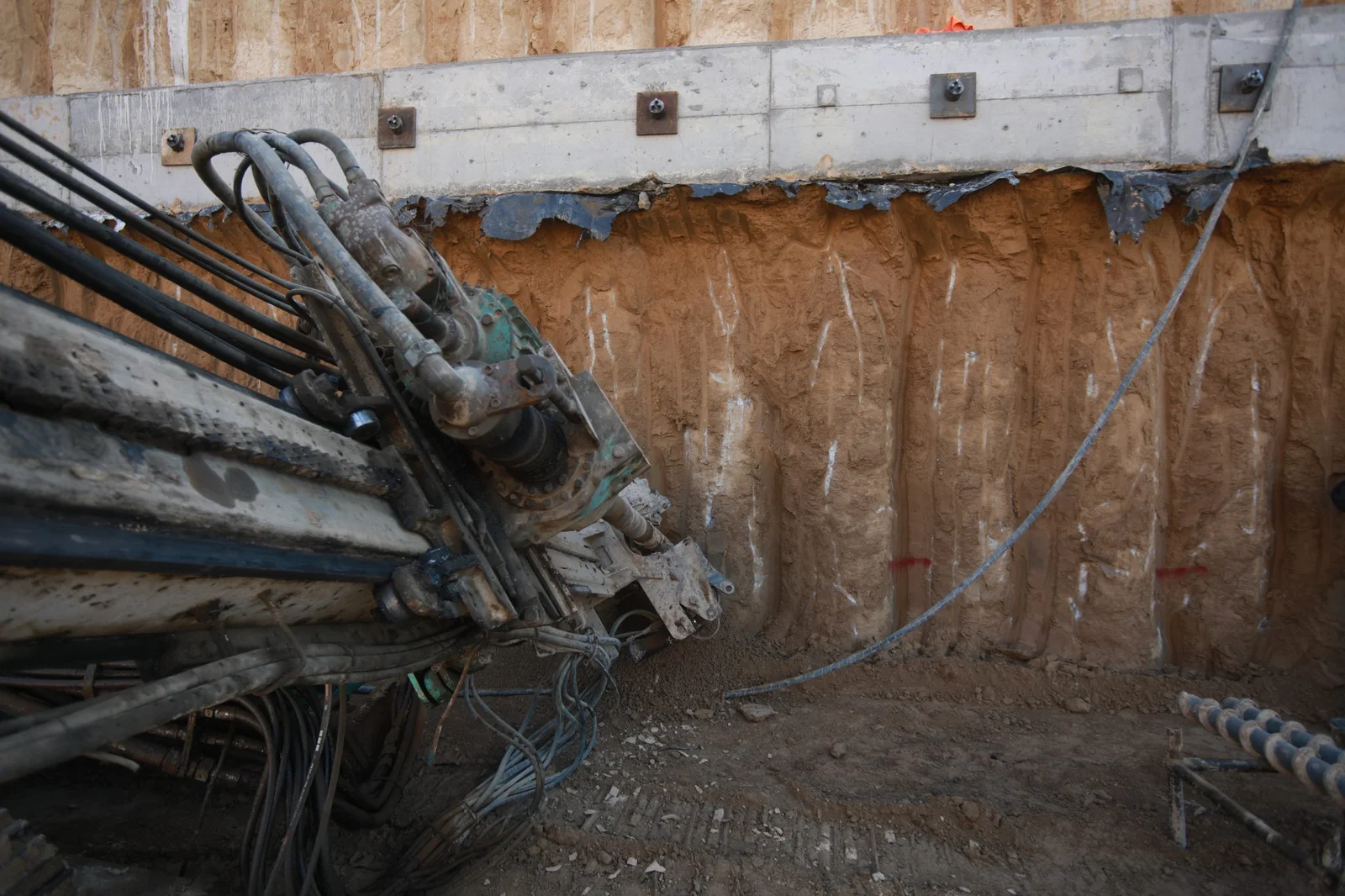
Ground Anchor Installation | Fen Zemin & İnşaat
Fen Zemin & İnşaat carries out ground anchor installation for deep excavations and retaining systems, with the construction method determined according to ground conditions, excavation depth, groundwater, surrounding structures and geotechnical design.
Prestressed ground anchors are used to transfer tensile forces from a retaining system into suitable soil or rock behind the potential failure zone. They may be combined with bored pile walls, reinforced concrete retaining elements or other excavation support systems.
At Fen Zemin & İnşaat, ground anchor installation is not treated as a drilling-only operation. Drilling, tendon installation, grouting, waler or bearing systems, stressing, lock-off and testing are considered as parts of the same geotechnical system.
What Is a Ground Anchor?
A ground anchor is a structural element installed in soil or rock to transfer tensile load from a structure into the ground.
Prestressed grouted ground anchors generally consist of three principal zones:
- anchor head and load-transfer assembly,
- free or unbonded length,
- bond length within the soil or rock.
The free length allows the tendon to elongate during stressing, while the bond length transfers the anchor force into the surrounding ground.
Anchor length and capacity should not be selected solely from excavation depth. Ground profile, potential failure surfaces, design load, groundwater, surrounding structures and deformation criteria must be evaluated together.
Where Are Ground Anchors Used?
Ground anchors are most commonly used in deep excavation and retaining projects.
Typical applications include:
- basement excavations,
- deep foundation pits,
- bored pile retaining walls,
- reinforced concrete retaining structures,
- slope stabilisation,
- infrastructure projects,
- road and transportation structures,
- excavations adjacent to existing buildings and roads.
Not every excavation requires ground anchors.
Depending on the project, a cantilever retaining system, internal bracing or another excavation support solution may be more appropriate.
How Does an Anchored Retaining System Work?
Excavation removes the lateral support previously provided by the ground in front of a retaining structure.
The retaining system must therefore resist the resulting lateral ground pressures and control movement.
In a bored pile wall, the piles may form the vertical retaining elements. At selected levels, walers or structural load-transfer elements are installed and ground anchors are drilled through the retaining system into suitable soil or rock.
The anchor bond length transfers load into the ground.
After the anchor has been grouted and the required conditions are met, the tendon is stressed and locked off at the specified load.
The system should therefore be considered as a combination of:
retaining wall + waler + ground anchor + surrounding ground
rather than as independent structural components.
Temporary and Permanent Ground Anchors
Ground anchors may be designed as temporary or permanent systems depending on their required service life and structural function.
Temporary Ground Anchors
Temporary anchors are commonly used to support excavation systems during construction.
Once the permanent basement walls, slabs or structural system are completed, the load path may change and the temporary anchors may no longer be required to perform their original function.
Permanent Ground Anchors
Permanent ground anchors are designed to remain part of the long-term structural system.
For this reason, durability, corrosion protection, tendon protection, materials and quality-control requirements may differ from temporary anchors.
Whether an anchor is temporary or permanent should be defined during design, not decided during construction.
How Is a Ground Anchor Installed?
Ground anchor construction consists of several connected field operations.
1. Design and Site Review
Before installation, the following anchor parameters are reviewed:
- level,
- location,
- inclination,
- total length,
- design load,
- free length,
- bond length.
Site conditions are also considered.
Adjacent buildings, foundations, utilities, property boundaries and available working space may directly affect the anchor geometry.
An anchor that appears straightforward on a drawing may not be practical to install under actual site conditions.
2. Anchor Drilling
The anchor hole is drilled at the specified location and inclination.
The drilling method depends on:
- soil or rock conditions,
- groundwater,
- borehole diameter,
- anchor length,
- stability of the drilled hole.
The ground encountered during drilling should be compared with the assumptions used in the geotechnical design.
It is particularly important that the anchor bond zone is formed within the soil or rock unit considered suitable in the design.
3. Tendon Installation
After drilling, the anchor tendon is installed into the borehole.
Prestressed ground anchors may use steel strands, bars or another tendon system defined by the project.
The free length and bond length need to be prepared correctly so that the anchor can elongate during stressing and transfer load through the bond zone.
The anchor head connection must also be suitable for later stressing and lock-off operations.
4. Grouting
Grout is introduced into the borehole to form the anchor bond zone and provide the required interface between the tendon and surrounding ground.
Grouting is not simply a process of filling the hole.
The bond zone must be capable of transferring the design load into the surrounding soil or rock.
The grouting method may vary depending on the anchor system, ground conditions and design requirements.
5. Waler or Load-Transfer System
The anchor load must be transferred into the retaining structure.
Depending on the project, reinforced concrete or steel walers may be used.
The anchor head, bearing plate and waler should work together as part of the retaining system.
6. Stressing and Lock-Off
After the anchor has reached the required condition, the tendon is stressed using hydraulic equipment.
The anchor is loaded according to the specified stressing procedure.
During this process, applied load and anchor movement are monitored.
After the required checks are completed, the anchor is locked off at the specified load.
This stage is a critical part of ground anchor installation.
The fact that an anchor has been drilled and grouted does not by itself demonstrate that it performs as intended under load.
Ground Anchor Testing and Quality Control
Because most of the anchor is located below ground, construction records and testing are important parts of quality control.
Depending on the project requirements, anchors may be tested under controlled loading.
During testing and stressing, the following may be monitored:
- applied load,
- anchor movement or elongation,
- load-holding behaviour,
- loading and unloading response.
The test procedure and acceptance criteria should be defined by the geotechnical design and technical specification.
A drilled and grouted anchor should not automatically be considered acceptable without the required stressing and testing process.
How Are Ground Anchor Length and Inclination Determined?
There is no single standard anchor length suitable for every excavation.
Total anchor length may depend on:
- excavation depth,
- soil or rock profile,
- potential failure surfaces,
- design load,
- surrounding structures,
- groundwater,
- required free length,
- required bond length.
The bond zone should extend beyond the critical failure mechanism into ground capable of transferring the design load.
Anchor inclination is also determined through engineering design and site constraints.
It should not be changed solely to make drilling easier.
How Do Ground Conditions and Groundwater Affect Anchors?
Ground anchors interact directly with the soil or rock in which they are installed.
For this reason, the same anchor geometry may behave differently in different ground conditions.
Clay, sand, gravel, fill, weathered rock and competent rock may require different drilling and grouting approaches.
Groundwater may affect bore stability, drilling procedures and grouting.
If the ground encountered during drilling differs significantly from the design assumptions, the technical implications should be reviewed before construction continues.
Fen Zemin & İnşaat evaluates actual drilling conditions together with the geotechnical design assumptions.
What Is the Difference Between a Ground Anchor and a Soil Nail?
Ground anchors and soil nails may look similar during drilling, but their structural behaviour is different.
A prestressed ground anchor is actively stressed and transfers a defined force into the ground before significant retaining-wall movement occurs.
A soil nail is generally a passive reinforcement element and develops load as the reinforced ground mass deforms.
For this reason, the two systems should not be treated as interchangeable simply because both involve drilled steel elements.
The appropriate system depends on excavation geometry, ground conditions, allowable deformation and geotechnical design.
How Are Bored Piles and Ground Anchors Used Together?
In deep excavations, bored piles may form the vertical retaining elements.
As excavation depth increases, the bored pile wall may require additional lateral support.
One or more rows of prestressed ground anchors can then be installed at specified levels.
Excavation usually progresses in controlled stages.
When the specified anchor level is reached, the anchor and waler system is completed and tested before excavation continues to the next stage.
For this reason, bored pile construction, excavation sequence and anchor installation must be coordinated.
What If Ground Anchors Cannot Be Used?
Ground anchors may not be feasible in every project.
Potential limitations include:
- neighbouring buildings,
- underground utilities,
- property boundaries,
- structural obstructions,
- legal or access restrictions.
Where anchors cannot be installed, internal bracing systems such as steel struts may be considered.
The appropriate alternative depends on excavation geometry, ground conditions, construction sequence and site use.
Ground Anchor Cost
Ground anchor cost should not be evaluated solely on a price-per-metre basis.
The total cost may be affected by:
- number of anchors,
- anchor lengths,
- borehole diameter,
- soil and rock conditions,
- tendon configuration,
- design loads,
- grouting method,
- stressing and testing requirements,
- waler system,
- working space,
- project location,
- mobilisation.
Two projects with the same total anchor length may have very different construction costs if the ground conditions and site constraints differ.
For this reason, Fen Zemin & İnşaat reviews the geotechnical design, anchor schedule and site conditions before preparing a quotation.
How Does Fen Zemin & İnşaat Evaluate a Ground Anchor Project?
The initial review begins with the available technical documents.
Where available, we review:
- geotechnical and retaining-wall design,
- ground investigation report,
- excavation sections,
- anchor levels,
- anchor lengths,
- anchor quantities,
- design loads.
The actual site conditions are then assessed.
Working space for the drilling rig, surrounding structures, roads, utilities, excavation sequence and other retaining-system activities can directly affect installation.
In restricted urban sites, anchor construction cannot be evaluated from total drilling length alone.
Working platform geometry, excavation stages and coordination with other site operations are important parts of the production plan.
Fen Zemin & İnşaat therefore evaluates ground anchor construction as part of the complete excavation support system.
Ground Anchor Installation in Istanbul and Across Türkiye
Fen Zemin & İnşaat is based in Ümraniye, Istanbul.
In addition to residential, commercial, urban redevelopment, basement and deep excavation projects in Istanbul, ground anchor projects in other parts of Türkiye may also be evaluated depending on project size, mobilisation requirements and site conditions.
Equipment, installation method, programme and site organisation are reviewed separately for each project.
Ground Anchor Frequently Asked Questions
What is a ground anchor?
A ground anchor is a structural element installed in soil or rock to transfer tensile load from a retaining structure or other structural element into the ground.
What is a prestressed ground anchor used for?
A prestressed ground anchor provides an active support force to a retaining system and can help control wall movement in deep excavations.
Why are bored piles and ground anchors used together?
Bored piles can form the vertical retaining wall, while ground anchors provide lateral support by transferring loads into suitable soil or rock behind the wall.
What is the difference between a temporary and permanent ground anchor?
Temporary anchors are generally designed to support construction-stage works. Permanent anchors are designed for long-term structural use and require appropriate durability and corrosion protection provisions.
Is a ground anchor the same as a soil nail?
No. Prestressed ground anchors are actively tensioned, whereas soil nails are generally passive reinforcement elements.
Are ground anchors tested after installation?
Depending on the project and technical specification, anchors are subjected to controlled stressing and load testing. The test method, load levels and acceptance criteria are defined by the design.
What determines ground anchor cost?
Anchor length, quantity, ground conditions, drilling method, tendon system, design load, grouting, testing, working conditions and mobilisation all affect total cost.
What information is required for a ground anchor quotation?
Where available, the retaining or geotechnical design, ground investigation report, anchor schedule, lengths, quantities, design loads, project location and site information should be provided.
Discuss Your Ground Anchor Project with Fen Zemin & İnşaat
For deep excavations, bored pile retaining walls and other prestressed ground anchor applications, you can share your project information with Fen Zemin & İnşaat.
Where available, provide the retaining design, ground investigation report, anchor schedule, quantities and site information so that the technical scope and quotation can be reviewed accurately.
Contact the Fen Zemin & İnşaat technical team to discuss your ground anchor project.